IQ Levels Explained: What Your IQ Score Means on an IQ Scale
People often search for IQ levels as if one score gives a complete answer. It does not. An IQ score can place someone roughly on a standard scale, but interpretation depends on test quality, confidence intervals, and context. This guide explains what common IQ ranges mean, what they do not mean, and how to read an IQ score more carefully.
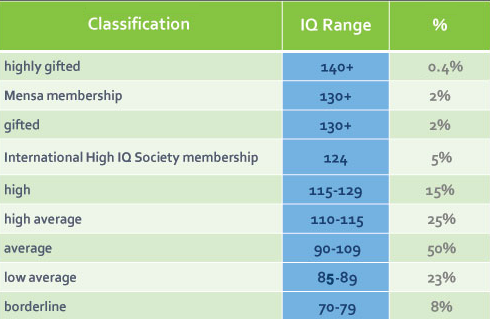
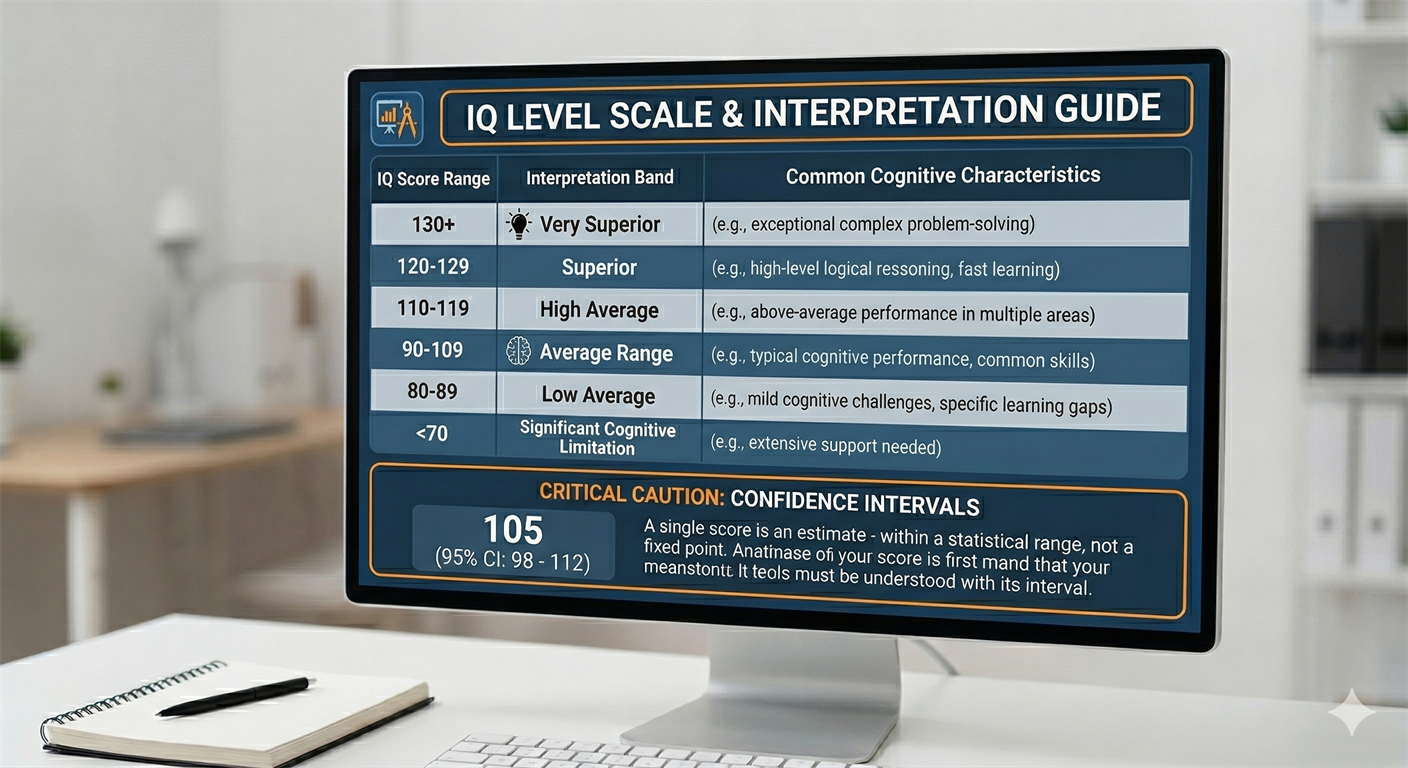
IQ level ranges at a glance
Many standardised IQ tests place the population average at around 100 and use broad ranges to show how far a score sits from that centre. The table below gives a rough guide only. Exact labels and cut-offs can vary across tests, and no single number should be treated as a complete description of a person.
| IQ score range | Broad interpretation | Important caveat |
|---|---|---|
| Below 70 | Very low range | Interpretation depends heavily on test quality, background factors, and broader assessment |
| 70–84 | Below average range | A single score should not be read without context and confidence intervals |
| 85–114 | Broadly average range | This is a wide band and still contains meaningful variation |
| 115–129 | Above average range | Higher scores do not automatically predict strong execution in every setting |
| 130+ | Very high range | High scores still need cautious interpretation and should not be treated as destiny |
For a pattern-reasoning example and practical testing guide, see Raven's Progressive Matrices.
Why one score is never the whole picture
A single IQ score should be interpreted cautiously for several reasons:
- Measurement error: a reported score is an estimate, not a perfect fixed point
- Test conditions: stress, fatigue, distraction, time pressure, and motivation can all affect performance
- Test differences: not all tests measure the same things with the same quality
- Context limits: an IQ score does not capture the whole of judgement, persistence, emotional regulation, or real-world execution
The useful question is not simply "What is the number?" but "How strong is the measurement, how stable is it, and what should reasonably be inferred from it?"
Confidence intervals and retest variation
A reported IQ score is an estimate with measurement error, not a fixed point. Retest variation, test conditions, and norm calibration all affect the plausible range around the score. That is why a careful interpretation uses confidence intervals and treats the result as an interval-informed signal rather than a deterministic label.
In practice, that means someone should be cautious about overinterpreting small differences between scores, especially when they come from different tests or different testing conditions.
What IQ levels can and cannot predict
IQ levels can support broad comparative context. They can sometimes help indicate where someone sits on a standardised reasoning scale, and they may relate to certain kinds of learning and problem-solving performance.
But IQ levels do not directly predict how well someone will execute under stress, recover after disruption, stay consistent across different task wrappers, or make sound decisions in every real-world setting.
For a more practical interpretation, combine scale placement with trend tracking and method checks:
Interpretation limits
IQ scores are estimates, not identities. Results vary by test quality, test conditions, age norms, confidence intervals, and retest effects.
Use IQ levels as a rough guide, not a final verdict.
FAQ
What is an average IQ score?
On many standardised IQ scales, the population average is set around 100. But "average" covers a broad band rather than one exact cut-off.
Is 123 IQ high?
A score of 123 is generally above average, but the practical meaning still depends on the test used, the confidence interval, and the context of interpretation. For benchmark framing beyond one score, see what a 123 IQ means.
Why do IQ scores vary between tests?
Scores can vary because tests differ in quality, norms, item types, timing, and testing conditions. Small differences should not be overinterpreted.
Your IQ score is a signal, not a ceiling.
A test result can help you understand your current performance, but the more important question is what you do next.
IQ Mindware trains the core systems behind general intelligence: attention control, working-memory capacity, reasoning and flexible problem-solving.
Start small with Mission Arena, or follow the full IQ Pro pathway with built-in IQ assessment.