How to Do a Raven Matrices Test
In this tutorial you will be given the following:
- An explanation of what matrices IQ tests are and how they are used
- A tutorial on strategies to solve Advanced Raven Matrices Test problems, with examples
- Information about the official Raven's Progressive Matrices assessment, plus an online Raven-style test so you can test yourself
- Links to additional Matrices Test resources
Matrices IQ Tests
Matrix reasoning tests are often described as non-verbal abstract-reasoning tests. They sample pattern discovery and problem solving under test conditions, and are commonly discussed as part of fluid intelligence (Gf) - a core component of g, or general intelligence.
In each test item, the subject is asked to identify the missing element that completes a pattern of shapes. The patterns are presented in the form of a 4x4, 3x3, or 2x2 matrix, giving the test its name. An example of a matrices test is shown here, from Smart-kit.com.
Because of the simplicity of their use and interpretation, and their independence of language and reading and writing skills, Matrices tests have widespread practical use - as a measure of intelligence in the general population for both adults and children, for job applicants as a psychometric test, for applicants to the armed forces, and for assessing clinical (e.g. Autism) populations.
Strategies To Get A High Score On A Matrices Test
Each Raven test has the same format: a 3 x 3 matrix in which the bottom right entry is missing, and must be selected from 8 alternatives.
Solving Raven's matrices type problems essentially requires figuring out the underlying rules that explain the progression of shapes.
Here is an example to try to figure out:
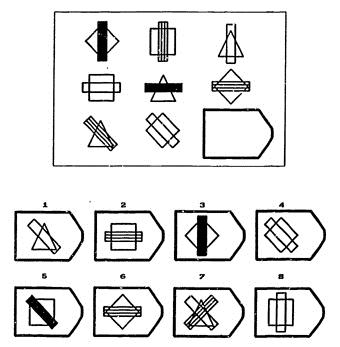
The correct answer is 5. The variations of the entries in the rows and columns of this problem can be explained by 3 rules.
- Each row contains 3 shapes (triangle, square, diamond).
- Each row has 3 bars (black, striped, clear).
- The orientation of each bar is the same within a row, but varies from row to row (vertical, horizontal, diagonal).
From these 3 rules, the answer can be inferred (5).
5 Rules For Matrices Problem Solving (Advanced Matrices Test)
John Raven designed all the problems for his Advanced Matrices test to be based on five basic types of rule. Each problem might have combinations of different rules or different instances of the same rule.
In order to solve Advanced Raven Matrices Test problems effectively, you will benefit from learning some rules.
1. Constant in a row
This is 'rule 3' in the matrix example above - the orientation of the bar is the same in each row, but changes down a column.
2. Quantitative progression
An increase or decrease between adjacent entries in size, position or number. An example of this rule is shown below:
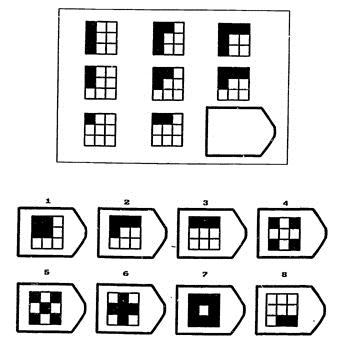
The correct answer is 3. The number of black squares in each entry increases in the top row from 1 to 2 to 3. Similarly, the number of black squares in the first column decreases from 3 to 2 to 1.
3. Figure addition or subtraction
A figure from one column is added to or subtracted from another column to produce the third. An example is given below:
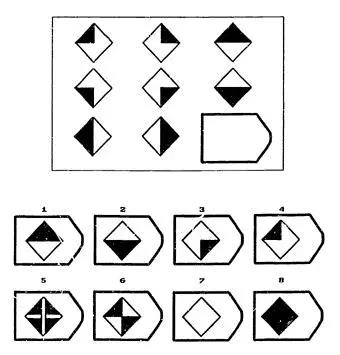
Correct answer 8.
4. Distribution of 3 values
Three values of a category such as shape are always present in each row. Two examples of this rule are shown in the first matrix we looked at above. Each row contains 3 shapes (triangle, square, diamond), and each row has 3 bars (black, striped, clear).
5. Method of Difference
Each element of a row is simply the DIFFERENCE (boolean operation) of the two other items in the row.
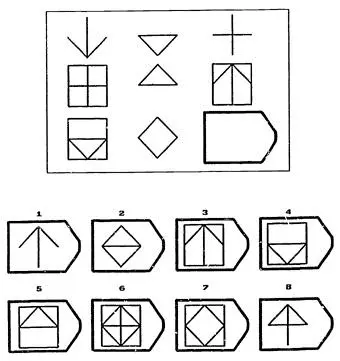
The correct answer is 5. Each figure element (horizontal line, vertical line, V shape) occurs two times in each row.
Finding Corresponding Elements
In problems with more than one rule, the problem solver must figure out which elements in the puzzle are governed by the same rule - something that can be called 'correspondence finding'.
An example of a correspondence problem is shown below:
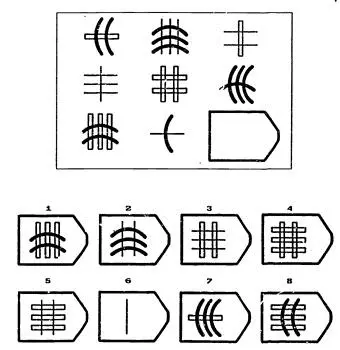
The correct answer is 5. Figuring out what corresponds to what requires that you form hypotheses in your mind and test them out. A hypothesis is an imagined explanation or prediction that needs to be tested.
In the example above, one hypothesis is that one rule applies to the bars, another rule applies to the dark curves, and another rule applies to the straight lines. Although it's true that each column has two of each type of shape, this hypothesis doesn't explain the number of the different elements. Another hypothesis is needed. Orientation (vertical or horizontal) can be the basis of the rules needed to solve this problem. In each row there are always 1, 2 and 3 horizontal elements and 1, 2 and 3 vertical elements. In addition to this, 1, 2 and 3 elements of each shape are distributed across the three rows.
Additional Training Resources
Alternative Matrices tests based on Raven's test and using similar principles can be found here (Italian text - the site is safe). To get your results after taking either test, you need to enter your age in the box provided and then click on 'IQ'.
Ready to train beyond matrix-test strategy?
Build the wider reasoning system Raven-style problems draw on
Learning the five rule types can improve how you approach a matrices test. IQ Pro goes beyond test familiarity by training attention control, working-memory capacity, relational reasoning and flexible problem-solving across changing tasks.
Use the Trident G pathway to practise holding multiple rules in mind, testing hypotheses, resisting attractive wrong answers and tracking progress beyond one puzzle format.
Inside IQ Pro:
- Zone Pulse readiness checks before demanding training
- Capacity Gym for attention and working-memory control
- Reasoning Gym for relations, constraints and inference
- Mission Arena for strategy and transfer-focused puzzles
- Built-in IQ and progress checks beyond daily game scores