More reach and opportunity
Learn from people anywhere, join communities, build with powerful tools, test ideas quickly and discover paths that once would have been invisible.
Human intelligence for the age of AI · Cognitive training · Cognitive coaching
Build intelligence for real-world adaptation.
Train the capacities that help you learn faster, think efficiently, adapt flexibly and stay effective under changing demands.
Ready to practise? Attention Control is available now — $20 one-off.
Adaptive intelligence under real constraints
Digital technology can expand what people can learn and do, but access to time, money, support, decision rights and practical alternatives remains uneven. Effective adaptation starts by asking what is actually constraining the situation rather than assuming that everyone has too many choices.
Learn from people anywhere, join communities, build with powerful tools, test ideas quickly and discover paths that once would have been invisible.
Feeds, alerts, recommendations and competing information can repeatedly pull control away from the goal that actually matters.
Work, caring, deadlines, financial pressures and accumulated commitments can leave too little spare attention to inspect what has changed or consider another route.
A possible path is not necessarily a feasible one. Skills, resources, permissions, support and cooperation affect which alternatives can actually be pursued.
The right adaptive move depends on the bottleneck. Recover headroom when demands crowd out thought. Open the search when the path is too narrow. Choose and protect a path when several options are genuinely viable. Reconsider it when reality changes.
Start with your experience
Choose a goal to see a possible starting point. These are everyday experiences, not diagnoses or a test of your abilities. More than one may fit.
Start by noticing what interrupts you and making one short block of work easier to protect. Attention Control offers focused practice selecting relevant information among competing signals.
Try this now: protect one 20-minute work block and count what actually pulls you away. Notice whether the main problem is external interruption, internal switching or uncertainty about what matters.
With AI, the same question matters: is its summary helping your goal, or drawing attention to the wrong things? Find the signal, coming soon, will practise checking that.
Explore Attention ControlAvailable now · $20 one-off
Bring a real task to coaching. Decide what kind of thinking it needs — understanding, critical evaluation, decision-making or strategic action — and where AI should assist rather than replace the judgement you need to retain.
Try this now: before asking AI, write down what a good answer needs to contain. Then compare its response with your criteria and note what it added, missed or distorted.
Explore coaching for AI useGuidance is available through coaching.
Try keeping the current goal and next step visible instead of holding everything in your head. Coaching can help you simplify instructions, meetings or complex tasks.
With AI, an editable map can make relationships visible. You still need to check the links and understand the essentials without it. Relational Memory and Binding Memory will explore these skills.
Explore personal coachingMemory training nodes are coming later.
Consider how you revisit and retrieve what you learn. A coaching plan can combine recall practice, useful cues and a study routine that fits your week.
When learning with AI, try recalling before asking for a hint. Check later what you can explain without the tool; Knowledge Access will build on this approach.
Explore a learning planKnowledge Access and memory nodes are coming later.
Choose one outcome, make the next action concrete and decide when to review it. Coaching can help you design a workable routine around competing demands.
With AI, compare possible paths and dependencies with your own prediction. Path Horizon will practise recognising when a plan should change.
Explore practical guidancePath Horizon is a future training node.
List the few options that are genuinely viable, decide what information could still change the choice, then set a review point rather than reopening the decision whenever a new possibility appears.
Try this now: ask what you would lose by spending another week exploring instead of acting. Execution, learning-by-doing and feedback also have value.
Explore adaptive-commitment coachingSeparate model progress from action progress and state progress. A better plan can be valuable, but the next useful step should eventually change something outside the planning process or return information from the world.
Try this now: name one external action, what you predict will happen, and when you will review the result.
Explore reality-anchored coachingFirst identify where time goes: finding information, deciding what matters or choosing a response. We can explore a simpler workflow and an appropriate balance between speed and accuracy.
AI may shorten part of a task, but checking and correcting its answer also takes time. Compare the whole workflow at a similar standard of accuracy.
Explore coaching for your taskFaster game responses do not establish faster thinking generally.
Look at the conditions as well as the task: interruptions, workload, fatigue and emotional distraction. Coaching can help you try a practical routine and review how it works in that situation.
With AI, keep a way to check, pause or continue if the tool is wrong or unavailable. Emotional training tasks are a proposed practice context; everyday resilience needs its own evidence.
Explore support for demanding situationsResilience is an everyday outcome to evaluate, not a promised training effect.
Make the decision explicit, separate what you know from assumptions and compare a few meaningful alternatives. Coaching can help you build a decision routine and learn from the outcome.
Try this now: write down your current best option, one serious alternative and the evidence that would make you switch. Then revisit the decision after you obtain one new piece of information.
With AI, generate your own options first, then use alternatives and counterarguments to test them. You keep the final judgement.
Explore decision coachingGenerative Search and Reasoning nodes are coming later.
Developing general intelligence is the central aim of Synergy IQ. Practise attention, memory and reasoning as a connected network, then use separate assessments to investigate whether progress extends beyond the games.
Also explore what becomes possible with AI. Assisted performance and retained understanding are valuable goals, measured separately from changes in general intelligence.
Explore intelligence and the evidenceSynergy IQ has not been established to increase IQ or general intelligence.
You do not need to know which cognitive process is involved. The same difficulty can have different causes, and a practical change may be the best first step.
Choose your support
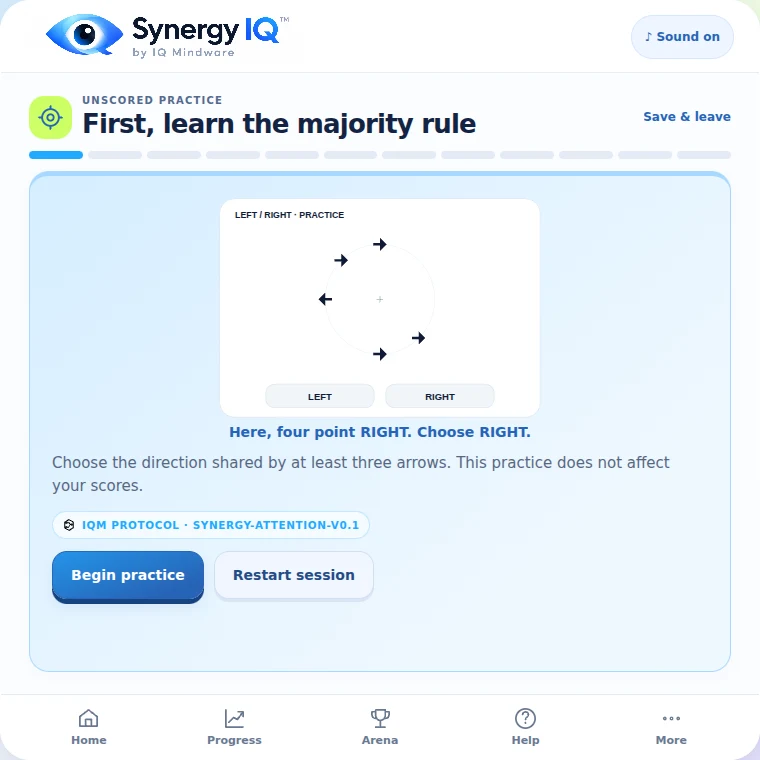
Use Attention Control to practise selecting what matters amid competing signals. Explore the app, its method and what its scores can tell you.
Meet Attention Control — $20 →Work with Dr Mark Ashton Smith on a real challenge. Combine practical strategies, thoughtful AI use and relevant training, then agree what to try and how to review it. AI is optional; your goal comes first.
Explore coaching options →01 / Start with attention
Practise selecting the information that matters while competing signals make the task harder.
A self-guided starting point if you want structured attention practice. Pair it with practical changes to how you work, and judge everyday progress separately from your game score.
02 / The developing network
Start with a cognitive skill. Each node also has an optional AI exercise coming soon for applying that skill with tools. Attention Control training is available now; the other nodes and all embedded AI exercises are still in development.
Practise selecting relevant information while competing signals demand attention.
With AI: Find the signal.
Explore the two kinds of practice → Available now · $20Meet the first nodePractise keeping relationships in mind and updating them as information changes.
With AI: Keep the whole problem in view.
Explore the two kinds of practice → Coming soonNotify mePractise keeping details, roles and sources attached to the right item.
With AI: Keep facts attached to their sources.
Explore the two kinds of practice → Coming soonNotify mePractise tracking sequences, dependencies and possible next states.
With AI: Explore what happens next.
Explore the two kinds of practice → Coming soonNotify mePractise retrieving useful knowledge when the question or cue changes.
With AI: Recall before reveal.
Explore the two kinds of practice → Coming soonNotify mePractise generating and comparing alternatives before settling on an answer.
With AI: Go beyond the first answer.
Explore the two kinds of practice → Coming soonNotify mePractise combining relationships and evidence to test a conclusion.
With AI: Put your conclusion to the test.
Explore the two kinds of practice → Coming soonNotify meThe aim is to test how development in one capacity relates to later learning in another.
Explore the ideaA programme in development, not seven products already available to buy.
The idea behind the network
A possibility-rich environment can demand different things at different moments: protect a signal, hold relationships, retrieve what matters, open alternatives, map where paths lead and constrain them with evidence. The seven-node programme explores these distinct but interacting training targets.
Mutualism is a theory of how general intelligence develops: cognitive abilities may support one another’s learning over time. Synergy IQ aims to use those interactions to develop general intelligence. We also ask whether some capacities contribute more strongly than others; the training effect remains a hypothesis to test.
Thinking also draws on notes, diagrams, other people and AI tools. Coaching explores how your skills and these supports work together in a real task, and what you learn from using them.
Explore the training model →A generative cognitive niche
Build your skills.
Learn how to use the tools.
Digital tools can extend cognition in useful ways. AI is the newest step: it can generate alternatives, organise a difficult problem and challenge an assumption. The aim is to gain that leverage while preserving human understanding, judgement, commitment and learning.
Personal guidance · Available now
In coaching, work through a task with Dr Mark Ashton Smith: clarify the goal, choose where AI could help and practise checking its contribution. Build a routine that fits how you work or study.
Inside the apps · Coming soon
Coming soon: a focused AI exercise for each training node — checking what matters, keeping track of sources, exploring alternatives or testing a conclusion.
These features are coming soon and are not yet included in Attention Control. AI may support learning or leave too much thinking to the tool. We will assess assisted performance, retained understanding and independent cognitive change separately; effects on IQ remain a research question.
Goals across the network
These goals can involve several capacities, practical strategies and optional AI use. They are outcomes to investigate, not promised benefits of buying an app.
Your own thinking: Practise retrieval and revisit knowledge after a delay.
With AI: Use hints and explanations while checking what you can later recall unaided.
Your own thinking: Compare time and accuracy on fresh tasks.
With AI: Count the time spent prompting, checking and correcting as well as generating an answer.
Your own thinking: Compare options, evidence and uncertainty.
With AI: Use alternative scenarios and challenges, then explain and own the final judgement.
Your own thinking: Explore strategies for distraction, emotional demands and recovery.
With AI: Practise spotting tool errors and continuing when AI is unavailable. Resilience is an outcome to evaluate.
Your own thinking: Explore how capacities support later learning across the network.
With AI: Test what people and tools achieve together, while measuring unaided general ability separately. Mutualist development remains a hypothesis.
Your own thinking: Choose a concrete work or study task and a useful measure of progress.
With AI: Compare a workflow with and without AI. Better output, retained understanding and skill development are different results.
A faster game score, a polished AI answer and an independent cognitive gain are not interchangeable. Agree what matters, then measure that outcome.
Keep learning from what happens
Choose a manageable step, look at what changes and use that information to decide what to do next.
Try a focused training task or a practical strategy suited to your goal.
Review the everyday result and what you learned. When using AI, distinguish assisted output from what you can do independently.
Keep what helps, revise what does not and choose the next manageable experiment.
Coming later: g loop — Apply and learn. A guided space to work through real challenges, choose where AI can help, and turn feedback into methods you can use again. This application layer will connect the seven nodes.
Improvement in a trained task does not by itself establish better everyday functioning, resilience or general intelligence.
05 / Map the adaptive system
G Track now combines the pilot Adaptive G Profile with separate cognitive benchmarks. Re-take the profile to map trajectories in stability, active learning, path control and reality coupling, while keeping matrix reasoning, attention and working memory as distinct objective measures.
Focused cognitive training and app-specific learning curves.
Repeatable Adaptive G profiles plus separate cognitive benchmarks.
Separate testing does not automatically remove practice effects or prove that training caused a change. Interpretation still needs appropriate comparisons.
06 / Science without the hype
Getting better at a game, carrying a skill into a different task, and improving general intelligence are different claims. We keep them separate.
Increasing general intelligence is the design aim. Whether Synergy IQ achieves that aim needs independent evidence; a higher game score alone cannot establish an IQ gain.
That performance improved on the trained task. Robustness under interference and recovery after a changed presentation are additional questions, not automatic evidence of broader transfer.
Improvement on a genuinely different, appropriate measure, interpreted against suitable comparisons. Delayed checks ask whether any change remains later.
Whether development in one node predicts how another is learned later. This future analysis is dormant, and observational relationships will not be presented as proof of causation.
No. Synergy IQ is cognitive training, not diagnosis or treatment. Neither training scores nor Arena positions are clinical assessments or IQ rankings.
Guidance from the founder
Work one to one with Dr Mark Ashton Smith to understand where things get difficult and choose a useful next step.
You can begin without app results. Bring a study routine, a demanding workflow, a decision or a question about using AI effectively.

Cognitive neuroscientist.
Founder of IQ Mindware.
Start with a recent example and the conditions around it, including interruptions, time pressure or fatigue.
Explore possible explanations and agree a practical strategy, workflow change, training route or combination.
Leave with written next steps and a clear way to check whether they help with the outcome you value.
Online, non-clinical coaching. One session or a three-session programme.
Bring your best to a 14-day challenge, with friendly rivalry and prizes to play for.
Prizes and entry details will be announced with each event.
Always optional. You can use Synergy IQ fully without taking part. Arena is for fun, not an IQ ranking.
Follow at your own pace
Choose to receive release news, optional Arena invitations and readable research notes.
No account or email signup is needed to explore this website. You can unsubscribe from updates at any time.
Opens our email signup form in a new tab. Privacy information.
Already training?
Training is one part of the loop. Return to the question that brought you here: what became easier, what still breaks under change, and what survives outside the game?
Use G Track when you want a separate cognitive measure rather than another training score.
Explore G Track →Compare the result you expected with what actually happened in work, study, decisions or AI use. Keep what helped; revise what did not.
Review it through cognitive coaching →Share a bug, confusing step or useful experience. Product feedback helps us refine the training and the communication around it.
Share feedback →