Define the pressure point
Specify the activity, outcome, affected participants, protected constraints and the practical consequence of the current friction.
Activity firstHow IQ Mindware works
Start with the task, workflow, pathway or learning process and the experience of the people inside it. Keep Capacity, Coupling, Niche and Mixed explanations alive, then test whether the best response is to develop capability, improve policy support, redesign the conditions or combine these approaches.
The CSI route
The activity goal, participant evidence, intervention and outcome remain distinct so that support is not confused with diagnosis or local app improvement with real-world change.
Specify the activity, outcome, affected participants, protected constraints and the practical consequence of the current friction.
Activity firstCompare capacity, policy–system coupling, environmental or institutional conditions and mixed hypotheses using operational, cognitive and participant evidence.
Evidence + confidenceChoose a low-risk, useful and preferably reversible Develop, Couple or Redesign intervention that can improve the outcome and discriminate among the leading explanations.
Informative interventionRe-measure functional outcomes, participant experience, cognitive evidence, agency and sustainability separately, then continue, adapt, stop or reopen the model.
Outcome + re-checkTwo connected surfaces
CSI should present different information to participants and institutional decision-makers. The purpose is to make both the system and the person more capable—not to create a hidden person-ranking layer.
A participant-facing surface can explain current evidence, preserve personal development records, accept pressure-point submissions and make review or correction routes visible.
Authorised decision-makers see appropriately aggregated workflow, pathway, cohort or programme patterns, with provenance, confidence and clear permitted-use boundaries.
Personal cognitive capital remains person-owned. Institutions may learn from appropriately aggregated intervention evidence without acquiring unrestricted personal cognitive profiles.
Cognitive agency as an outcome
Understand whether difficulty is better explained by capacity, coupling, system conditions or interaction.
Raise a pressure point, choose an appropriate route and participate in the design of a bounded test.
Build portable capability through transparent learning demands, applied missions and participant-controlled evidence.
Retain model ownership, provenance, verification rights, human review and a viable unaided capability.
Beyond repetition
IQ Mindware is designed to ask more than “did you improve on the exercise you practised?” Development is one possible CSI response, not the answer to every system problem.
Recover the same underlying operation when the format, point of view or context changes.
Check whether performance can be regained after time away from the task.
Measure a defined work, learning, service, research or performance outcome separately from app performance.
Architecture and status
G Track and Cognitive Control Coach are available now. Pattern & Prediction Coach and Applied Reasoning Coach extend the route to structured prediction and applied judgement. These tools are selected only where the constraint model supports their use.
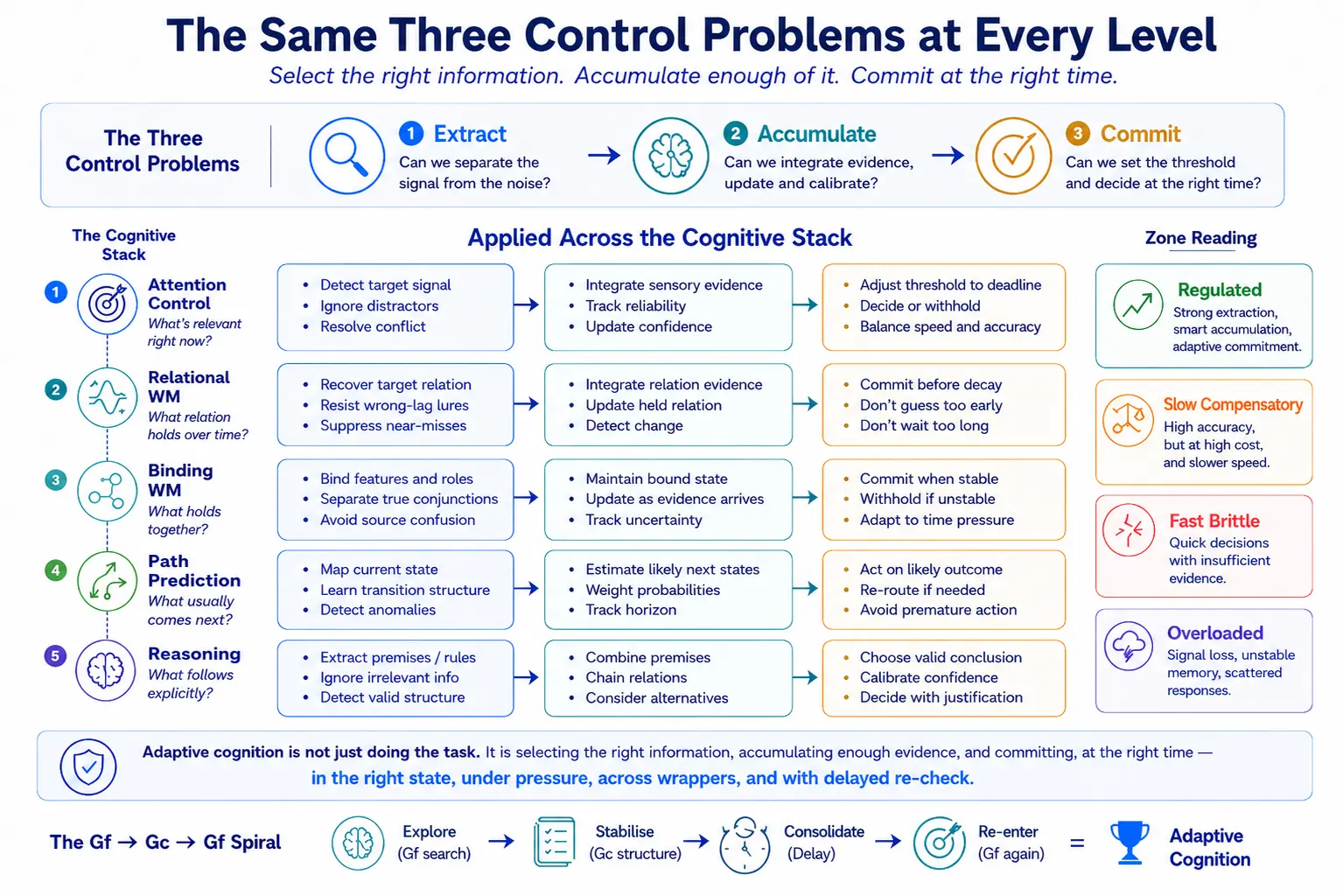
Explore the appsThe detailed model maps recurring control problems—signal, evidence, predictive calibration and commitment—across attention, structured memory, prediction and reasoning. CSI locates those operations inside the wider person–policy–AI–niche system.
Start with an individual development goal or one bounded organisational or institutional pressure point.