IQ Pro method

The Trident G
Far Transfer Protocol™

Train for transfer, not just practice.

IQ Pro is built to strengthen 'in the zone' readiness, working memory and reasoning under changing demands — ensuring these gains still hold beyond one familiar task.

The model

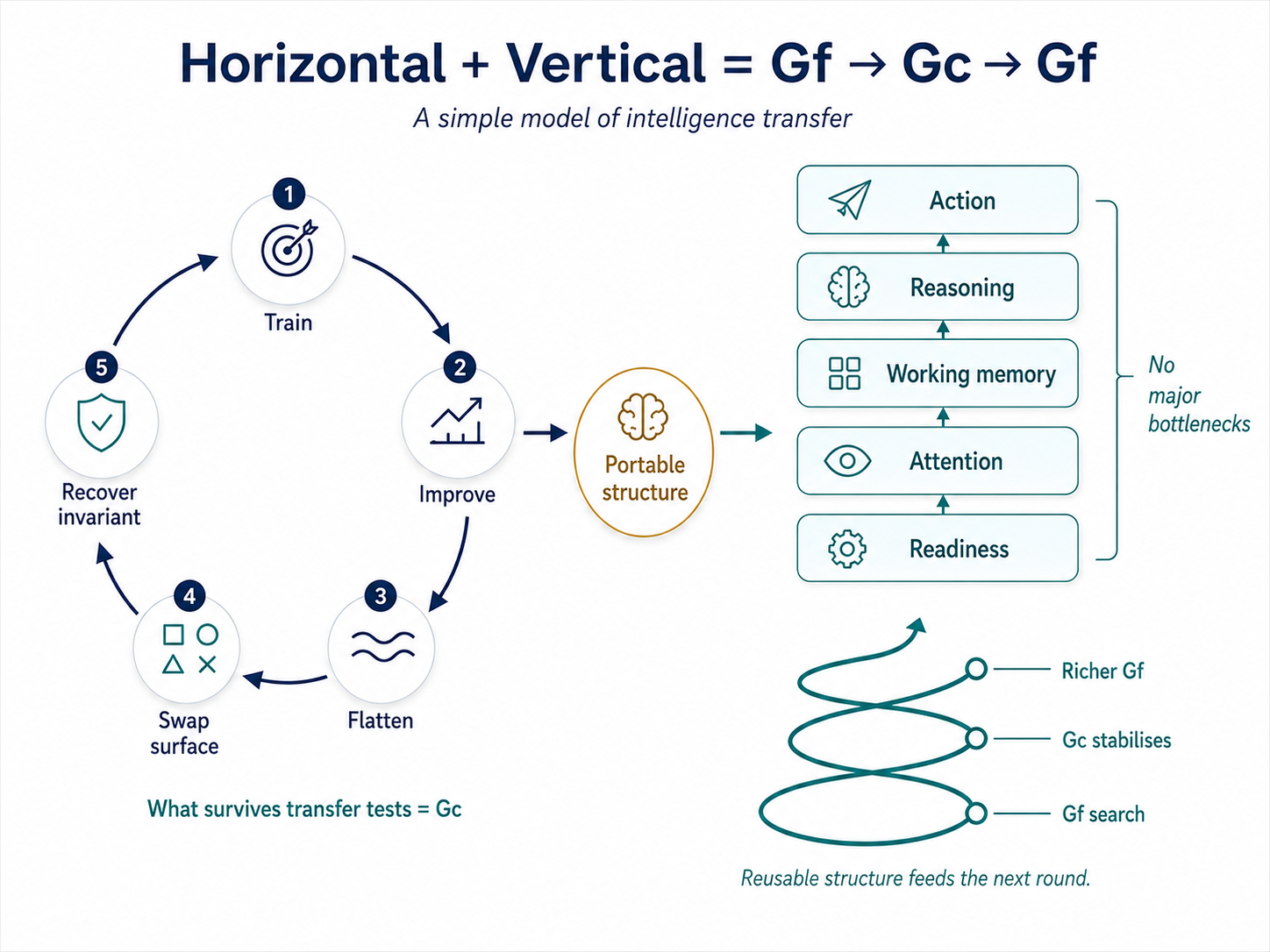
A simple model of intelligence transfer

Horizontal and vertical transfer combine in the Trident G model to produce a Gf to Gc to Gf learning spiral
The Trident G model combines horizontal variation, vertical progression and real life re-checks. The goal is to build IQ-related cognitive skills that can be recovered when the task, format or problem changes.

The simple idea is this:

Improvement matters most when it becomes reusable.

You can get better at one exercise because its timing, layout and rules become familiar. That may be useful, but it does not automatically mean the same thinking skill will carry into a new problem.

The Trident G Far Transfer Protocol™ is designed around a stronger question:

Can the same useful structure survive change?

That means training is not only about repetition. It is about learning, adapting, recovering and applying.

Three linked stages

How the protocol works

01

Horizontal change

Change the surface. Keep the core challenge.

The task format changes while the underlying thinking demand remains similar.

A user may first learn a pattern, rule or relation in one format, then meet the same kind of challenge in a new surface: a different layout, wrapper, task type or problem form.

The question is:Can the same relation or strategy be recovered when the surface changes?

02

Vertical progression

Move from control to reasoning.

The protocol also increases the depth of the challenge.

Training moves through a simple vertical route:

readiness → attention → working memory → reasoning → action

The aim is not just to make one task faster. The aim is to build the active mental workspace needed for clearer problem solving: holding relevant information, resisting distraction, tracking relations and deciding what follows.

The question is:Can lower-level control support higher-level thinking?

03

Re-checks

Check what still holds later.

A score can rise during practice and still fade when the format changes or the skill is revisited later.

That is why IQ Pro separates daily training from progress checks. Re-checks ask whether progress still holds when familiar supports are reduced, conditions vary or the challenge is revisited after delay.

The question is:Does the gain survive change, delay or practical re-use?

The transfer problem

Why transfer is difficult

Practice effects are not the same as transfer.

Repeating a task can make its cues, timing and response pattern more familiar. That can improve performance, but it does not automatically show that the underlying thinking skill has become portable.

01

Trained-task dependence

A score can rise inside one exercise while staying tied to its exact format.

02

Narrow automation

Practice can make a task feel easier without requiring the learner to recover the same relation or strategy in a new form.

03

Fragile carry-over

A gain may weaken when the format changes, the reasoning demand increases or the skill is revisited later.

The Trident G Far Transfer Protocol™ is a design response to this problem. It builds change, progression and re-checking into the training pathway.

The training system

How IQ Pro applies the protocol

IQ Pro turns the model into a guided training path.

  1. 01

    Zone Pulse

    A short readiness check helps estimate whether the standard route or an adjusted route is appropriate before the main session begins.

  2. 02

    Coach-led routing

    The day’s work is guided by readiness and programme position, rather than giving every user the same session in the same way every time.

  3. 03

    Capacity Gym

    Capacity Gym trains the active workspace behind problem solving: attention control, working-memory control, updating, interference control and keeping relevant information available under load.

  4. 04

    Reasoning Gym

    Reasoning Gym uses that workspace for relation matching, rule use, constraint solving and must-follow inference.

In simple terms:
first build the workspace, then use it.

Programme structure

The 20-session pathway

IQ Pro uses short daily sessions with staged progression.

  1. Estimate readinessZone Pulse checks whether the standard or adjusted route is appropriate.
  2. Route the sessionThe coach guides the dose, balance and pathway.
  3. Train capacityAttention and working-memory control are practised under adaptive demand.
  4. Apply controlReasoning tasks require relations, rules and constraints to be maintained and used.
  5. Introduce changeSurfaces and reasoning demands vary across the pathway.
  6. Check separatelyProgress checks remain distinct from daily training completion.
The learning spiral

The Gf → Gc → Gf spiral

The protocol uses a simple learning spiral.

  1. Gf searchyou meet a new challenge and search for the right pattern, relation or strategy.
  2. Gc stabilisesuseful structures that survive practice, variation and re-checking become more stable.
  3. Richer Gflater, you return to new problems with better mental tools available.

So the aim is not to bank fluency with one game.

The aim is to bank portable structure.

That is the difference between getting better at a task and building intelligence that can adapt.

Evidence boundary

Progress and evidence

Completing training is not evidence of transfer by itself.

Daily training shows what was practised. Progress checks ask a different question: whether performance changes when familiar supports are removed, conditions vary or the skill is revisited later.

The evidence layer is kept separate on purpose. Stronger claims require more than engagement or rising in-app scores.

Read the proof and claims boundary →
Technical detail

For deeper readers

The page above gives the simple version. The full formal protocol explains the underlying theory, transfer logic, bottleneck model, delayed consolidation framework and validation boundary in more detail.

Read the formal protocol on GitHub →