Dual N-Back Training Strategies
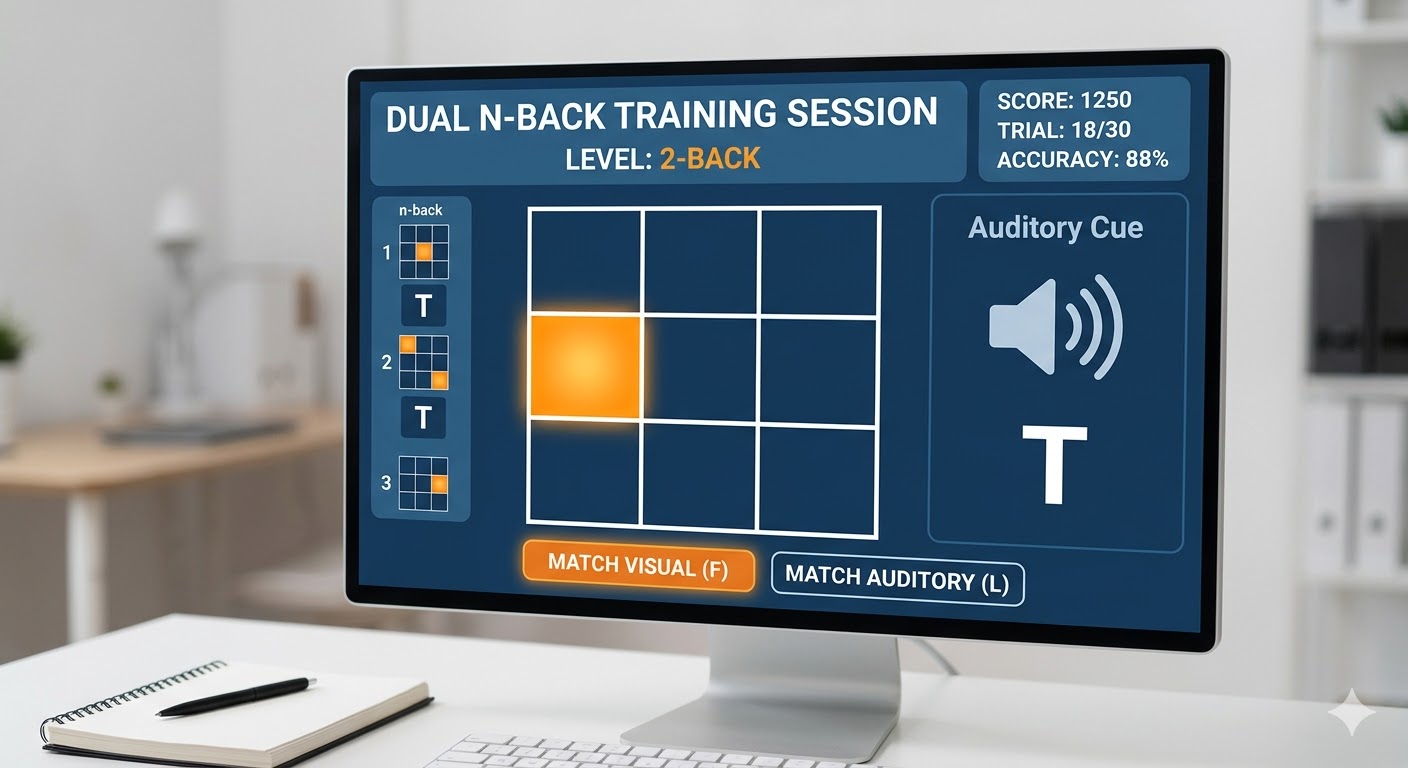
Dual n-back training is often treated as a simple endurance task, but the real issue is method. This guide first defines the key terms, then explains the training objective: far transfer, meaning gains that hold up beyond the exact exercise you practised. It then covers weekly structure, session design, plateau fixes, carryover checks, common mistakes, and the IQ Mindware capacity-training profile at the end.
Key terms used in this guide
Dual n-back is a working-memory task where you track two streams of information, usually something you see and something you hear, and respond when the current item matches one from a set number of steps back.
Working memory means the active mental workspace you use to hold, update, and manipulate information while solving a problem. Updating under load means keeping that workspace accurate while new information keeps arriving.
Interference is the confusion created by old, similar, or distracting information. A lure is an item that feels like a match but is not the correct match.
Carryover, or transfer, means improvement shows up beyond the exact training task. Far transfer means the improvement survives a bigger change, such as a new format, a reasoning task, a delayed re-check, or a real-world use case.
A task wrapper is the surface form of a task: letters, sounds, locations, objects, rules, timing, or screen layout. A swap cost is the extra effort, delay, or error rate that appears when the task wrapper changes.
State-gated training means checking whether your attention and control state is ready for demanding training before starting the hardest work. Relational working memory means holding relationships in mind, such as "A is above B", "this rule changes that outcome", or "if this changes, what follows?".
A protocol is a structured training method: what you do, when you progress, what you measure, and how you decide whether the result counts.
How often should you train each week?
For most users, consistency beats volume. Start with short sessions three to five times per week and protect recovery between harder blocks. Increase challenge only when performance is stable across multiple sessions. If quality drops, reduce load before adding more volume. The aim is stable repetition with useful feedback, not constant escalation.
A simple dual n-back session template
A good session should be short enough to preserve control and long enough to expose weak points.
-
Warm-up block
Begin with one short block at a manageable level. The purpose is not to impress yourself. It is to settle attention and detect obvious drift early.
-
Main blocks
Run a small number of focused blocks at your working level. Keep the emphasis on clean responding rather than squeezing out one more round when concentration is already slipping.
-
Stop rule
End the session when control quality starts to deteriorate, not when motivation alone fades. Pushing through obvious decline often reinforces noise rather than useful adaptation.
-
Brief review
Take a minute to note what went wrong. Was the problem distraction, overload, rushed responding, interference between streams, or general fatigue?
-
Progression rule
Raise difficulty only when performance is stable over multiple sessions. Do not mix progression with random increases in session length, because this makes it harder to see what is actually helping.
Why plateaus happen and what to change first
Plateaus usually come from uncontrolled progression, fatigue carryover, or weak error review. They are often a sign that training has become noisy rather than properly structured.
Change one variable at a time:
- session length
- progression threshold, meaning the performance level needed before raising difficulty
- spacing between sessions
- review loop, meaning the short check of what went wrong and what to change next
Avoid changing several things at once. That hides which adjustment actually improved performance.
Plateau checklist
When progress stalls, work through these in order:
-
Shorten the session
A session that is too long can turn useful strain into sloppy repetition.
-
Check progression drift
You may be increasing difficulty faster than control has stabilised.
-
Review error pattern
Look for the dominant problem. Is it attention drift, interference, unstable pacing, or overload?
-
Check spacing and recovery
Too little recovery between harder sessions can flatten performance.
-
Only then increase volume again
More training is not always better training. Restore quality first.
How to check whether training carries over
Carryover should be tested in changed conditions, not assumed from gains inside the exercise. A higher n-back level is useful information, but it is not enough on its own. The more important question is whether control survives outside the original task wrapper: the exact screen layout, stimulus type, timing, and response format you practised.
Useful signs of carryover include:
- steadier focus under distraction
- fewer drop-the-thread moments
- better re-entry after interruption
- improved control in another demanding task
- lower swap cost, meaning less drop-off when conditions change
Use the capacity training tool for training blocks that adjust difficulty, inspect how carryover is checked, review emotion-and-load findings in emotional dual n-back evidence, and compare the current training routes.
What carryover looks like in practice
The strongest sign of progress is not just "I got a better score today." It is something closer to: "I held the thread better under load", "I recovered faster after interference", or "I stayed more stable when the task changed." Treat gains inside the exercise as a clue. Treat performance under changed conditions as the stronger check.
Common training mistakes
Chasing one high score
This often produces unstable sessions and poor learning signals.
Training too long
Fatigue can look like discipline, but it often muddies the process.
Changing too many variables at once
You lose sight of what improved performance.
Ignoring error type
Not all mistakes mean the same thing. Drift, overload, rushing, and interference call for different adjustments.
Assuming transfer
Improvement inside the task should be checked outside the task.
FAQ
How often should I do dual n-back training?
For most people, three to five sessions per week is a sensible starting point. Prioritise regularity and control quality over sheer volume.
How long should a session be?
Long enough to expose weak points, but short enough to keep performance clean. A smaller number of focused blocks is usually better than one long grind.
How do I know whether dual n-back is helping?
Do not rely on training scores alone. Look for better control under distraction, cleaner re-entry after interruption, and steadier performance in changed conditions.
Should I raise the difficulty every session?
No. Increase challenge only when performance is stable over multiple sessions. Constant escalation can create noise and premature plateaus.
From dual n-back to IQ Mindware capacity training
Dual n-back is useful because it trains updating under load: you have to hold recent information in mind, resist interference, and respond accurately as the task changes. But in IQ Mindware, n-back is not treated as the whole intervention. It is one layer of a broader capacity training protocol.
The aim is to train the active workspace for transfer. That means not only remembering items, but holding variables, tracking relations, resisting lures, and updating predictive "if this, then what follows?" structures under pressure. In Trident G terms, this is training the working space that supports reasoning, problem solving and strategic action.
That is why IQ Mindware capacity training extends beyond standard dual n-back in three ways:
-
State-gated training
Training works best when attention is stable enough to learn. IQ Mindware uses short readiness checks to estimate cognitive-control state before deeper training.
-
Relational working-memory training
Instead of only asking "did this item repeat?", the protocol increasingly asks whether a relation, binding, pattern or transformation has been maintained across time. A binding is a link between pieces of information, such as a colour tied to a location; a transformation is a change rule, such as rotate, reverse or increase.
-
Transfer testing
The important question is not just whether your n-back score improves. It is whether control survives changed task wrappers, delayed re-checks, reasoning tasks and real-world use.
Technical note: the far-transfer protocol in IQ Mindware
Relational n-back in IQ Pro should be treated as successor-representation working-space training. A successor representation is a learned map of likely next states: given the current state, what states, consequences or options become reachable next? In training terms, this means exercising the user's ability to hold variables, bindings and predictive transitions under controlled load.
The target is not simple item recall. The target is the capacity to maintain and update relational structure such as:
state -> transition -> consequence -> next reachable state
This aligns with emerging evidence that fluid intelligence is associated with the brain's ability to integrate separately encountered information into map-like relational representations, rather than with non-relational item memory alone. The training target should therefore be framed as behavioural relational integration: holding structured relations online, protecting them from interference, updating them across time, and using them to support inference.
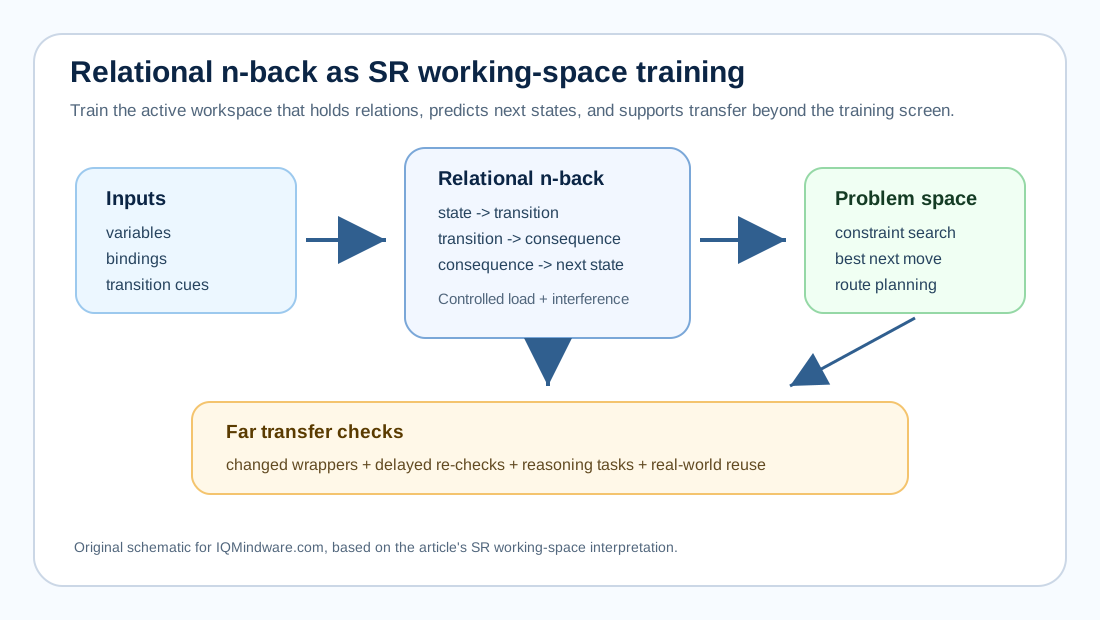
This working space should then feed into problem-space puzzles, where the same trained capacity is used for constraint search, best-next-move selection, probe choice, route planning and strategy switching. IQ Mindware's relational n-back is designed to train the active workspace for relation tracking and successor-style inference, then test whether that workspace remains useful outside the original exercise.
Research context:
- Kahn, A. E., Bassett, D. S., & Daw, N. D. (2025). Trial-by-trial learning of successor representations in human behavior. bioRxiv.
- Rangarajan, P., & Rao, R. P. N. (2026). Hierarchical active inference using successor representations. arXiv.
- Tenderra, R. M., & Theves, S. (2025). Human intelligence relates to neural measures of cognitive map formation. Cell Reports, 44(8), Article 116033.
The target profile: a larger rapid-inference workspace
The suggested target profile is not simply "high n-back scorer". It is a person with a more usable cognitive workspace: steadier attention, better updating under interference, richer relational tracking, and clearer evidence about whether those gains carry over beyond the training screen.
The theory behind this is that useful capacity training should expand the space of rapid problem-solving inferences you can make. In everyday terms, that means you can see more of what follows from the current situation without losing the thread. In Trident G terms, this connects with hippocampal successor representations: mental maps of likely next states, outcomes, or implications. The hippocampus is a brain system involved in memory and relational mapping; a successor representation is a learned sense of "given this, what is likely to come next?".
IQ Mindware capacity training is designed around that profile: state-gated training to protect learning quality, relational working-memory tasks to hold richer structures in mind, and transfer testing to see whether the trained control can be reused in new wrappers, delayed re-checks, reasoning tasks, and real-world work.
Ready to move beyond dual n-back?
Train the wider capacity system behind intelligence
Dual n-back trains updating under load. IQ Pro takes that idea further with a full Trident G training pathway: readiness checks, adaptive capacity training, relational working-memory challenges, reasoning practice and progress checks beyond the daily games.
Use IQ Pro to train the active mental workspace needed to hold rules, track variables, resist lures and reason under changing demands.
Inside IQ Pro:
- Zone Pulse to check your Cognitive Bandwidth before training
- Capacity Gym for attention, updating and working-memory control
- Reasoning Gym for relation matching, constraints and must-follow inference
- Mission Arena included for puzzle-based transfer practice
- Built-in IQ and progress checks to track gains beyond game completion