The rise of cognitive elites: how college, work and AI are re-sorting society
Mass higher education opened doors. It also created new filters, new bottlenecks, and a sharper divide between those clustered in high-information institutions and those outside them.
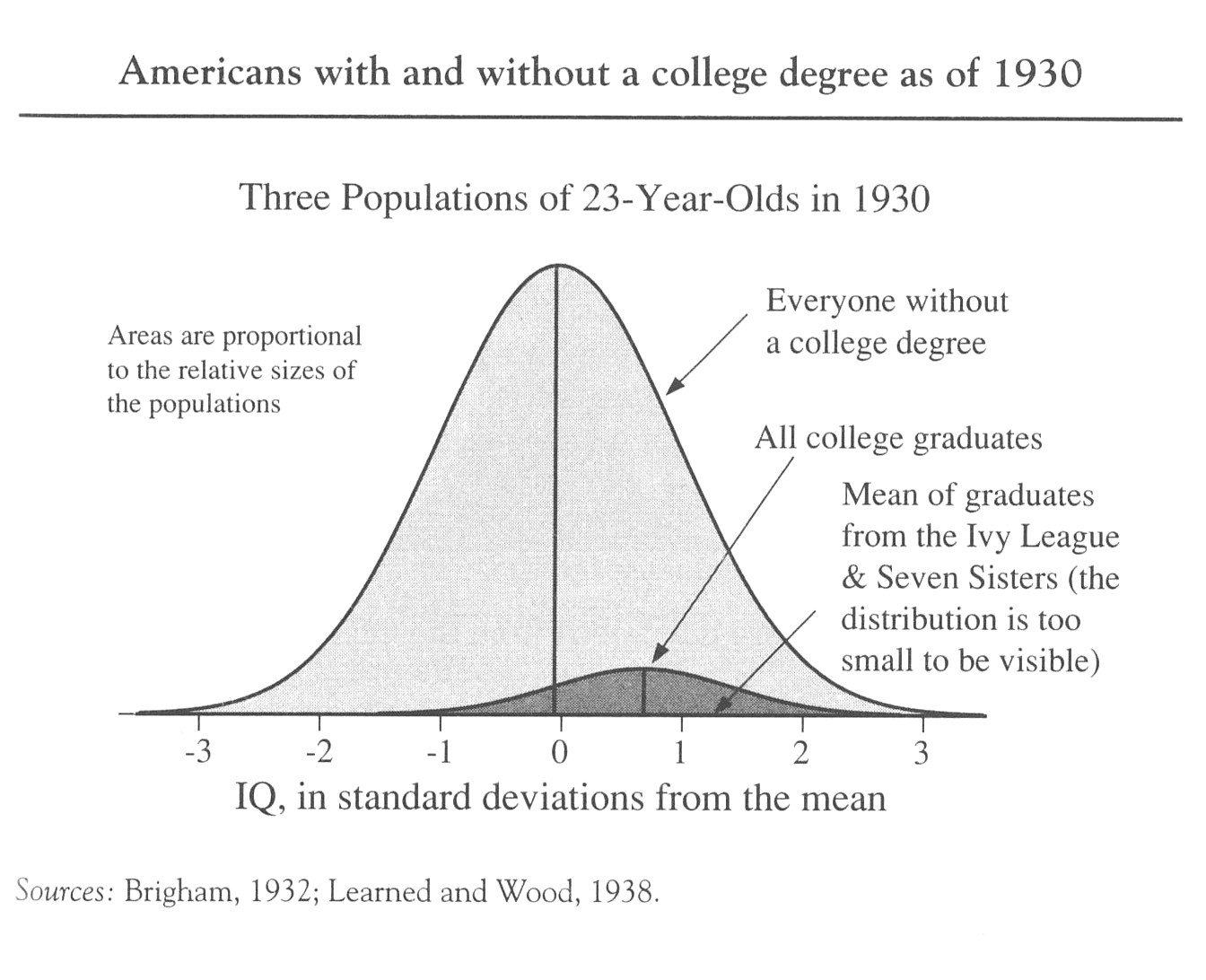
The phrase "cognitive elite" entered public debate through the 1990s, but the underlying question is still with us: what happens when a society gets much better at sorting people through education, credentials, and cognitively demanding work? The broader hereditarian claims tied to that debate remain heavily contested, and later reviews have stressed that trends linked to test scores cannot simply be read as fixed or purely genetic. But one narrower point has proved harder to dismiss: modern societies do seem to channel a growing share of high-performing, highly credentialed people into the same institutions, occupations, places, and family networks.
From mass higher education to sharper sorting
Your first figure captures an older America in which college graduates were a much smaller slice of the population. In that world, high ability, ambition, wealth, and social status did not map as tightly onto a single educational track. There were certainly elites, but the system was less efficient at pulling the brightest and most advantaged people through the same formal pipeline.
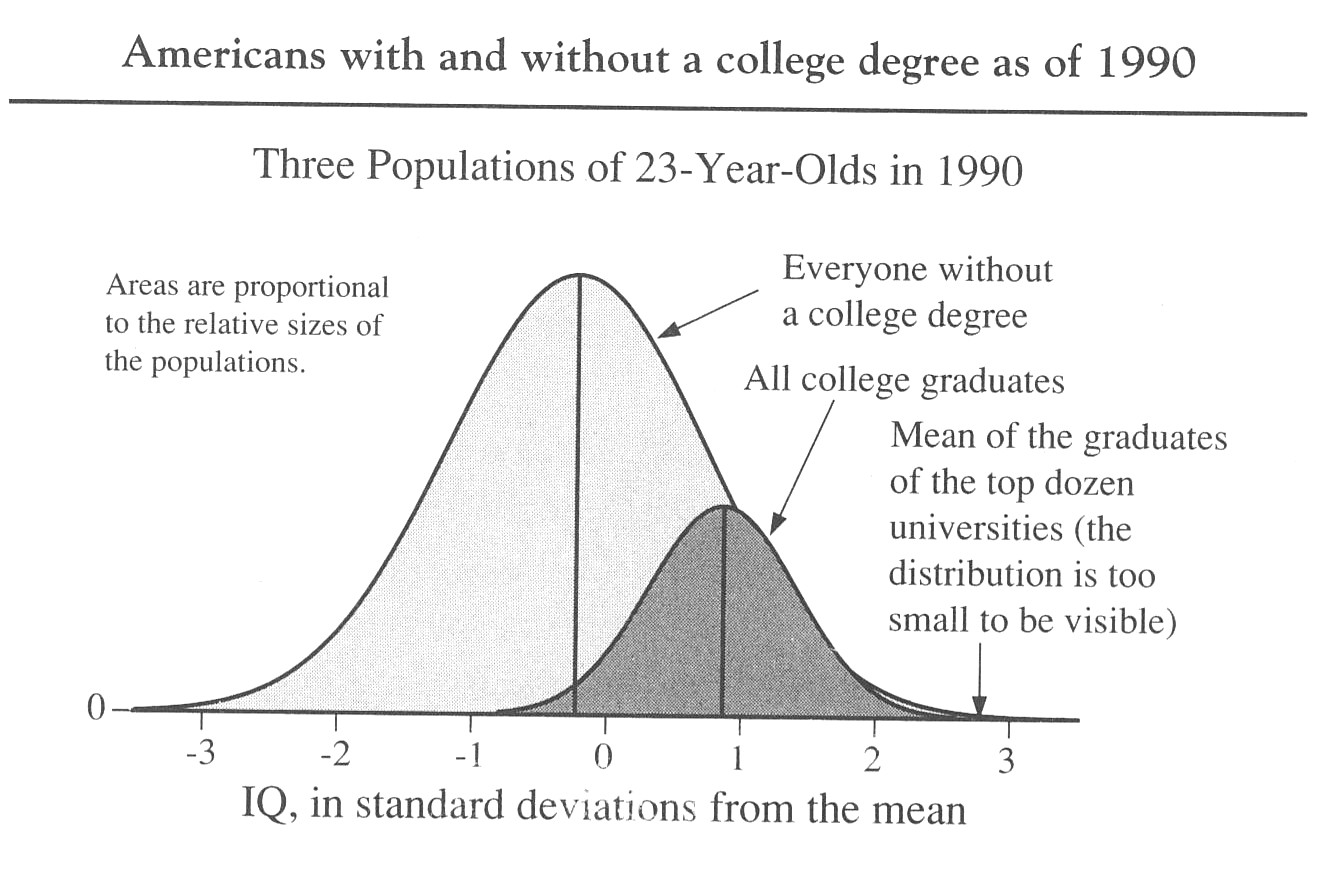
By 1990, the picture had clearly changed. College had expanded massively, and the graduate population had become much larger. But the deeper change was not just quantity. It was sorting. Once more people entered higher education, the decisive question shifted from whether one went to university to which university, which degree, which occupational track, and which social networks followed from it.
That process did not stop in 1990. In the United States, the share of 25- to 29-year-olds with a bachelor's degree or higher rose from 32% in 2010 to 40% in 2022, and remained 40% in 2023. So the expansion of higher education has continued. But expansion has not dissolved hierarchy. It has raised the floor of participation while leaving the upper tiers intensely stratified.
The college degree divide in the professional class
You can see the consequences in the labour market. In 2024, median weekly earnings for Americans aged 25 and over with a bachelor's degree were $1,543, compared with $930 for those with only a high-school diploma. Unemployment was 2.5% for bachelor's degree holders versus 4.2% for high-school graduates. Census data also show that by 2024, households headed by someone with a bachelor's degree or higher had 2.3 times the income of households headed by someone with only a high-school degree, up from roughly 2 times in 2004. In other words, the college degree divide has not faded with mass access. In key respects, it has hardened.
The modern version of the "cognitive elites" pattern is therefore not just an IQ story. It is a credential story, an institution story, and a labour-market story. Census data released in 2025 show that 44.5% of employed workers in 2024 had a bachelor's degree or higher, but that figure rose to 76.5% in professional and related occupations and 64.2% in management, business, and financial occupations. These are precisely the roles that shape ideas, strategy, capital allocation, administration, law, technology, and the symbolic life of the economy. That is the modern professional class divide.
Elite universities, meritocracy and inequality
The bottleneck becomes even clearer at the top. Recent NBER research on Ivy-Plus admissions found that applicants from families in the top 1% of the income distribution were 58% more likely to be admitted than middle-class applicants with similar SAT/ACT scores. Part of that advantage came through legacy preferences and athlete recruitment. Separate NBER work has also found that income segregation across colleges is comparable to income segregation across neighbourhoods in the average American city. So the upper reaches of the education system are not just talent filters. They are also mechanisms of social reproduction.
Educational assortative mating and cognitive polarisation
Then there is the family dimension. One classic fear in discussions of cognitive stratification was that educational and cognitive sorting would eventually move from schools into marriage and family formation. The modern evidence is more nuanced than the old popular narratives suggested, but it still points in that direction. One major NBER study found long-run positive educational assortative mating in the United States dating back to 1940 and concluded that it contributes meaningfully to cross-sectional household inequality. Another study concluded that assortative matching in the US has increased, particularly at the top of the education distribution. The upshot is not a simple hereditary caste system. It is a more modest but still important point: education, partnership, and inequality increasingly reinforce one another.
This is also now a geographic story. Research summarised by Brookings notes that US regions with fewer college-educated workers have tended to grow more slowly. That means cognitive polarisation is not just about individuals; it is also about metros, clusters, and whole local economies. Some places accumulate universities, graduate talent, high-status firms, and dense professional networks. Other places lose them, and the gap compounds.
AI and the future of work
The 2020s add another layer: AI may intensify the pattern rather than dissolve it. The World Economic Forum's 2025 report says that analytical thinking, creative thinking, resilience, flexibility, agility, and technological literacy are among the skills becoming even more important. Brookings finds that more than 30% of workers could see at least half their occupational tasks disrupted by generative AI, with particularly strong exposure in middle- to higher-paid cognitive professions. The IMF likewise argues that college-educated workers are more exposed to AI, but also better positioned to benefit from it, while labour-income inequality could rise if AI complements higher-income workers more strongly than others. In plain English: the new economy is not moving away from cognitive sorting. It may be doubling down on it.
What "cognitive elites" should mean today
So are we seeing cognitive polarisation in the 2010s and 2020s? Yes, but not in the simplistic sense that one fixed trait explains everything. The stronger claim is institutional. Higher education has expanded, but returns remain steep. Elite universities still act as powerful bottlenecks. Professional and managerial occupations are densely degree-filtered. Educationally similar people are still more likely to pair off. High-skill metros pull further ahead. And AI is increasing the premium on analytical, symbolic, and strategic labour even as it reshapes who can do what.
That is why "cognitive elites" remains a useful phrase, provided we use it carefully. It should not mean a biologically fixed aristocracy. It should mean a social layer increasingly clustered in selective institutions, cognitively intensive work, high-opportunity regions, and similarly educated households. The divide is real. But it is built through schools, labour markets, family formation, capital, and technology, not through IQ alone.
Bottom line
The rise of mass higher education did not abolish elite formation. It changed its machinery.
Ready to build your cognitive advantage?
Train for a more demanding AI economy
This article's central point is that education, work and technology increasingly reward people who can manage complex information and make sound decisions. Credentials can open doors, but they do not replace the cognitive systems used once the work begins.
IQ Pro provides a structured Trident G pathway for training attention control, working-memory capacity, relational reasoning and flexible problem-solving under changing demands.
Inside IQ Pro:
- Zone Pulse readiness checks before demanding training
- Capacity Gym for attention, updating and working-memory control
- Reasoning Gym for relations, constraints and logical inference
- Mission Arena for strategy and puzzle-based transfer practice
- Built-in IQ and progress checks beyond daily game scores