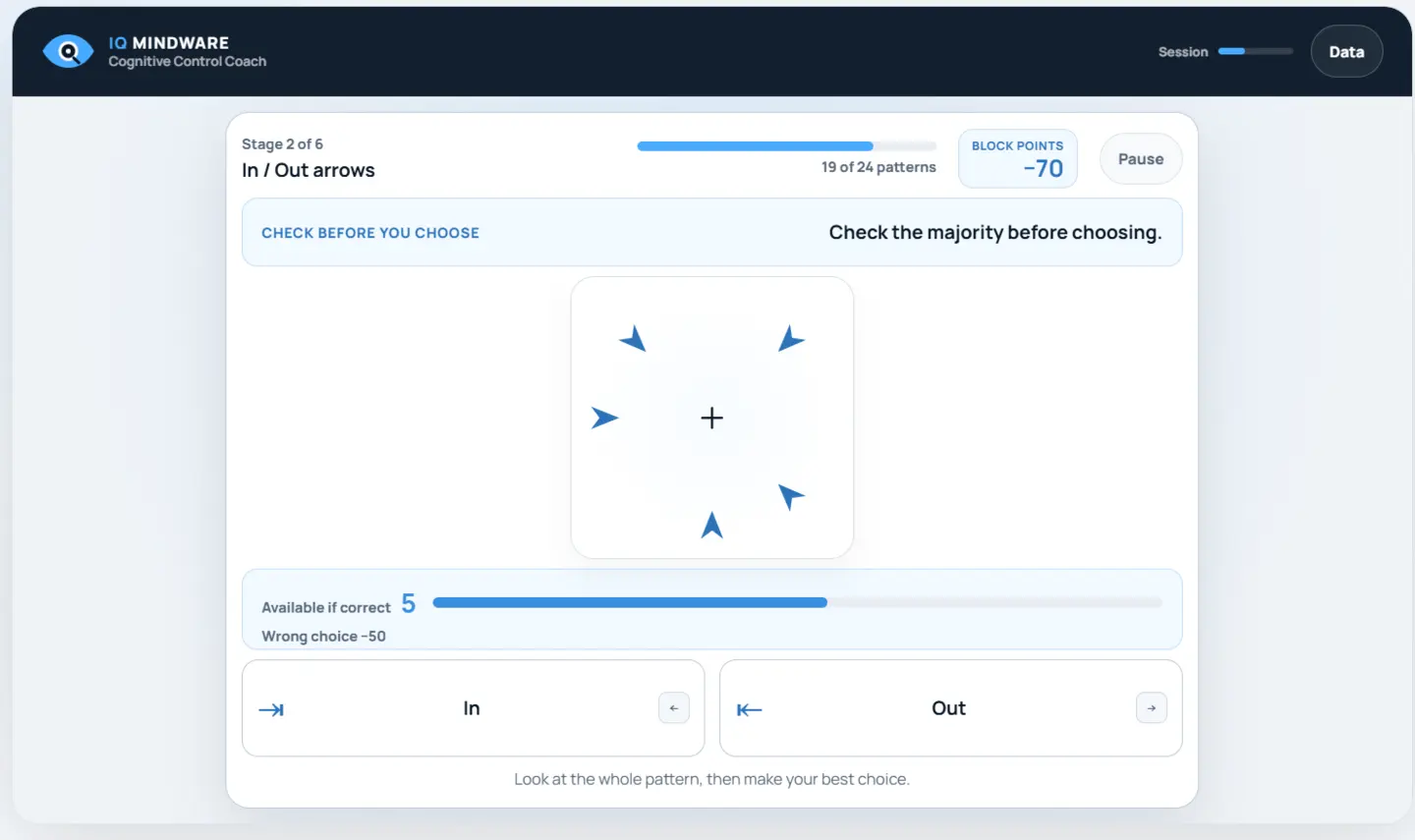
Cognitive Control Coach is a research-informed cognitive control training app that exercises a connected sequence: find the relevant signal, hold its relation in working memory and make a well-timed choice. Its tasks vary the visual format, pace, evidence clarity and consequences so that success cannot depend on one fixed routine. In-app improvement is useful practice evidence, but broader transfer requires separate tests.
Cognitive Control Coach is now the legacy combined programme. Its attention-control component has become the first dedicated Synergy IQ node. Read the current Attention Control guide, see its place in the network, or buy Attention Control for $20. Existing Cognitive Control Coach customers retain support for the older programme.
Cognitive control is often described as concentration or resistance to distraction. Both are important, although they capture only part of the problem. In work, study and complex everyday activity, control usually involves selecting relevant information, retaining the relationships that matter as the situation changes, and deciding when the evidence is sufficient to act.
Cognitive Control Coach was designed around this wider sequence. It combines majority-signal attention tasks, relational working-memory demands, contrasting decision environments and deliberate changes in task format. The complete programme is new and is being calibrated and validated. Its component mechanisms have credible research foundations, but the effects of the integrated programme must be tested directly.
What is Cognitive Control Coach?
Cognitive Control Coach is an IQ Mindware web application for practising attention control, relational working memory and decision timing. A session presents compact perceptual problems in which several arrows or moving elements contribute evidence towards an overall In or Out relation. The user must extract the majority signal, sometimes retain that relation across intervening trials, and choose under a changing balance of clarity, delay and error cost.
Find the signal. Hold the context. Make the call.
This phrase describes the task architecture rather than three independent abilities. A working-memory comparison is only useful if the right signal entered memory, while a correct representation can still be poorly used if commitment comes too early or after unnecessary delay. The Coach therefore trains the points at which attention, memory and decision policy constrain one another.
The Coach sits alongside IQ Mindware’s broader cognitive-control evidence guide and the practical guide to decision thresholds and overchecking. This page focuses on the app: what users are asked to do, why the tasks are organised in this way, and what conclusions can reasonably be drawn from progress.
Why cognitive control is more than focus
A researcher must separate a meaningful result from noise, retain the relations between findings and decide when enough evidence has accumulated to support a conclusion. A manager faces the same control problem in a different form when priorities compete, information changes and another check may either prevent an error or merely postpone a reversible action.
These examples do not mean that an abstract training task is equivalent to professional judgement. They show why a useful model of cognitive control needs more than sustained attention. Control must remain effective as the relevant signal, memory load, response rule and consequences change. The Coach turns that sequence into controlled practice, while keeping real-world transfer as a separate empirical question.
Find the signal: attention control under interference
The first training problem is extraction. A brief pattern contains several local signals, but the correct response depends on the dominant direction or relation across the whole pattern. Some trials are clear; others contain nearly balanced evidence. The user must identify the majority rather than respond to one conspicuous arrow or moving element.
The closest published precursor is the masked Majority Function Task, in which participants judge the direction taken by most arrows after a brief presentation. In a controlled study of 84 healthy young adults, seven days of this training produced improvement on selected conditions of an attention-network task and some verbal-learning trials, alongside changes in event-related brain potentials during other cognitive tests (Zhang et al., 2024).
What this supports
Majority-signal practice offers a controlled way to exercise attentional selection and conflict resolution. The effects in the study were not uniform across every outcome, so it does not establish a general improvement in executive ability or intelligence.
Hold the context: relational working memory
Conventional n-back tasks usually ask whether a current letter, position or picture is identical to one presented earlier. The Coach uses a relational version. After extracting an In or Out relation, the user may need to decide whether that relation matches the one observed one, two or more trials previously. The surface pattern can change while the relation to be remembered remains stable.
This distinction matters because higher cognition frequently depends on relationships rather than isolated items. Following an argument, comparing explanations or understanding a changing system requires us to retain how pieces of information are connected. Experimental work by Li and Birney found that performance reflecting relational integration and attentional control together was more predictive of fluid intelligence than either process treated in isolation (Li & Birney, 2026).
This is mechanistic evidence, not proof that training the combination increases intelligence. More direct but still preliminary training evidence comes from a small randomised study in which one month of numerical relational n-back practice was associated with changes in resting EEG microstates relative to an active-control group (Wang et al., 2025). The distinctive findings concerned brain dynamics rather than a replicated increase in general intelligence.
Make the call: decision timing, not permanent speed
Cognitive control is not always improved by responding faster. The appropriate point of commitment depends on evidence quality and the consequences of waiting or being wrong. A fast response may be appropriate when the signal is clear and delay is costly. Greater caution may be warranted when evidence is ambiguous and an error carries a substantial penalty.
Evidence-accumulation models describe information building towards a decision threshold. Lowering that threshold generally favours speed; raising it generally favours accuracy but demands more evidence and time. Research shows that people can adjust this balance as task conditions change, although their adjustment is not always optimal (Drugowitsch et al., 2015; Tardiff et al., 2025; Kalburge et al., 2026).
Clear Sprint
Evidence is generally clear and delay is costly. The useful response is timely commitment rather than repeated checking.
Calculated Risk
Evidence may be close, but waiting also consumes value. The task requires a proportionate choice under remaining uncertainty.
Clean Precision
Errors are expensive even when the answer may already be clear. The challenge is to protect accuracy without adding empty delay.
Deep Check
Evidence is often difficult and additional inspection can be valuable. Deliberate slowing may therefore be the better policy.
The four environments are designed to prevent one permanently fast or permanently cautious style from being rewarded in every situation. The training target is adjustment: changing the point of commitment as clarity, available time, reward and error cost change. These laboratory mechanisms support the design principle, but they do not yet show that training in the Coach improves decisions at work or in daily life.
Why the task changes from arrows to moving dots
One of the central problems in cognitive training is that a person can improve at the repeated exercise without acquiring a portable control skill. Familiarity with one visual display, timing pattern or response routine can raise the score while leaving performance brittle when the same underlying rule appears differently.
The Coach therefore changes the visual wrapper. A relation first represented by arrows can later appear through optic-flow patterns. The visible material changes, while the underlying requirement—to extract the dominant relation and use it correctly—remains related. Research in perceptual and predictive learning suggests that carefully chosen variability can reduce dependence on incidental surface features and broaden generalisation (Manenti et al., 2023; Ram et al., 2024).
Related work indicates that people can learn compressed representations which retain task-relevant structure while discarding unnecessary detail, and can later recognise new sequences that share an abstract motif (Fang & Sims, 2025; Wu et al., 2025). These findings make controlled wrapper change a plausible training principle; they do not guarantee transfer between the exact arrow and optic-flow tasks used by the Coach.
How the Coach looks for recovery and transfer
Immediate improvement after repeated practice can reflect familiarity, a short-lived strategy or adaptation to one format. It does not by itself show that learning has become portable. The Coach therefore looks for a sequence that is more demanding than task completion:
- Performance stabilises in the original format.
- The same underlying control problem appears in a changed format.
- The initial performance dip is measured rather than hidden.
- Practice continues until performance recovers.
- The original format returns to check that it remains intact.
- Formats are mixed so that the relevant rule must be identified again.
- A protected or held-out version checks performance without immediate coaching.
- A delayed return asks whether the capability can be re-entered later.
This sequence distinguishes completion from cognitive training transfer. A recent randomised trial in older adults illustrates why the distinction matters: relational training improved the trained relational ability, but did not produce a significant advantage on non-verbal intelligence or broader neuropsychological and quality-of-life outcomes (Meijer et al., 2026). Improvement in a trained operation and improvement in a broader outcome are separate questions.
What the feedback and progress measures mean
The Coach reports measures such as response accuracy, median decision time, working-memory balanced accuracy and the points kept under the current consequence structure. These measures help distinguish different patterns of performance. The same accuracy can be reached through well-timed choices or through costly delay, while a faster median response may be useful in one environment and poorly calibrated in another.
No single in-app number should be interpreted as a new IQ score or proof of broad cognitive improvement. The measures are most useful when they answer narrower questions: did signal selection become more reliable, did a relation remain available across the required interval, did the decision policy change with the environment, and did performance recover after the format changed?
What is the reversible-sphere “Shift the View” exercise?
At selected first-time transitions, the Coach includes a brief field of moving dots that can be perceived as a rotating sphere. Its apparent direction can reverse even though the stimulus has not fundamentally changed. Bistable perception is scientifically useful because it shows that the same sensory evidence can support more than one coherent interpretation.
Within the Coach, Shift the View is brief and unscored. It marks a transition before the task changes format. It is not presented as a treatment, neurological reset or independently validated way to improve cognitive flexibility. Research suggests that intentional control over perceptual reversals has a more complicated relationship with cognitive flexibility than passive reversal alone (Koivisto & Pallaris, 2024).
What the evidence supports—and what it does not
Supported design principles
Majority-signal tasks can exercise attention under interference; relational maintenance is more than simple item memory; decision policies can adapt to changing evidence and consequences; and controlled variability can encourage less surface-bound representations.
Claims that require separate evidence
The integrated programme has not yet been shown to increase intelligence, improve occupational performance or change everyday decisions. Those outcomes require appropriate, preferably independent measures beyond the trained tasks.
IQ Mindware uses a claims ladder for this reason. Improvement on the practised task is practice evidence. Performance in a changed wrapper is changed-format evidence. A different assessment provides separate-measure evidence. Retention after time provides delayed evidence. Demonstrable benefit in work, study or daily life would be an applied outcome. Each step supports a stronger conclusion and therefore needs stronger measurement.
Current evidence position
Cognitive Control Coach combines research-grounded attention exercises with emerging approaches to relational working memory, adaptive decision timing and transfer-oriented practice. Its component mechanisms have credible empirical foundations, while the integrated programme and its effects beyond trained tasks are undergoing direct validation.
The wider IQ Mindware evidence framework explains how claims, protocols and data summaries are kept distinct. You can also compare the Coach with the other IQ Mindware apps or see how apps fit into the Trident G platform.
Cognitive Control Coach FAQ
What does Cognitive Control Coach train?
It trains attention control, relational working memory and decision timing as task format, pace, evidence clarity and consequences change. These are practised as a connected control sequence rather than three isolated drills.
Is Cognitive Control Coach just an attention game?
No. Attention is the first part of the sequence. The Coach also asks users to retain relations across trials and adapt when they commit as the evidence and costs change.
What is relational working memory?
Relational working memory retains and compares how information is organised rather than memorising only its appearance. In the Coach, the user may decide whether a current In or Out relation matches one presented earlier even though the individual pattern is different.
Why are there four decision environments?
Clear Sprint, Calculated Risk, Clean Precision and Deep Check alter evidence clarity, time pressure and error cost. This means that one permanently fast or cautious response style is not always rewarded.
Does improvement in the Coach prove far transfer?
No. Better performance in the trained tasks is practice evidence. Changed-format, separate-measure, delayed and applied outcomes require progressively stronger evidence and should be reported separately.
Is Cognitive Control Coach an IQ test or medical treatment?
No. It is a research-informed skills-training application, not an official IQ test, clinical assessment, diagnosis or medical treatment.
References
- Drugowitsch, J., DeAngelis, G. C., Angelaki, D. E., & Pouget, A. (2015). Tuning the speed–accuracy trade-off to maximize reward rate in multisensory decision-making. eLife, 4, e06678. https://doi.org/10.7554/eLife.06678
- Fang, Z., & Sims, C. R. (2025). Humans learn generalizable representations through efficient coding. Nature Communications, 16, Article 3989. https://doi.org/10.1038/s41467-025-58848-6
- Kalburge, I., Dallstream, A., Josić, K., Kilpatrick, Z. P., Ding, L., & Gold, J. I. (2026). Human decision-makers terminate evidence accumulation using flexible decision rules [Reviewed preprint]. eLife. https://doi.org/10.7554/eLife.111082.1
- Koivisto, M., & Pallaris, C. (2024). Cognitive flexibility moderates the relationship between openness-to-experience and perceptual reversals of Necker cube. Consciousness and Cognition, 122, 103698. https://doi.org/10.1016/j.concog.2024.103698
- Li, Y., & Birney, D. P. (2026). Relational integration and attentional control are crucial to fluid intelligence together but not alone. Journal of Intelligence, 14(1), Article 8. https://doi.org/10.3390/jintelligence14010008
- Manenti, G. L., Dizaji, A. S., & Schwiedrzik, C. M. (2023). Variability in training unlocks generalization in visual perceptual learning through invariant representations. Current Biology, 33(5), 817–826.e3. https://doi.org/10.1016/j.cub.2023.01.011
- Meijer, Z., Delabie, M., De Houwer, J., & Cummins, J. (2026). Can relational training improve cognitive functioning and subjective complaints in older adults? A randomised controlled trial using SMART. Collabra: Psychology, 12(1), 158603. https://doi.org/10.1525/collabra.158603
- Ram, H., Grinfeld, G., & Liberman, N. (2024). Anticipated variability increases generalization of predictive learning. npj Science of Learning, 9, Article 55. https://doi.org/10.1038/s41539-024-00269-z
- Tardiff, N., Kang, J., & Gold, J. I. (2025). Normative evidence weighing and accumulation in correlated environments. eLife, 13, RP100258. https://doi.org/10.7554/eLife.100258
- Wang, Z., Sun, T., & Xiao, F. (2025). Relational integration training modulated the frontoparietal network for fluid intelligence: An EEG microstates study. Brain Topography, 38, Article 24. https://doi.org/10.1007/s10548-024-01099-3
- Wu, S., Thalmann, M., & Schulz, E. (2025). Two types of motifs enhance human recall and generalization of long sequences. Communications Psychology, 3, Article 3. https://doi.org/10.1038/s44271-024-00180-8
- Zhang, H., Fan, S., Yang, J., Yi, J., Guan, L., He, H., Zhang, X., Luo, Y., & Guan, Q. (2024). Attention control training and transfer effects on cognitive tasks. Neuropsychologia, 200, 108910. https://doi.org/10.1016/j.neuropsychologia.2024.108910