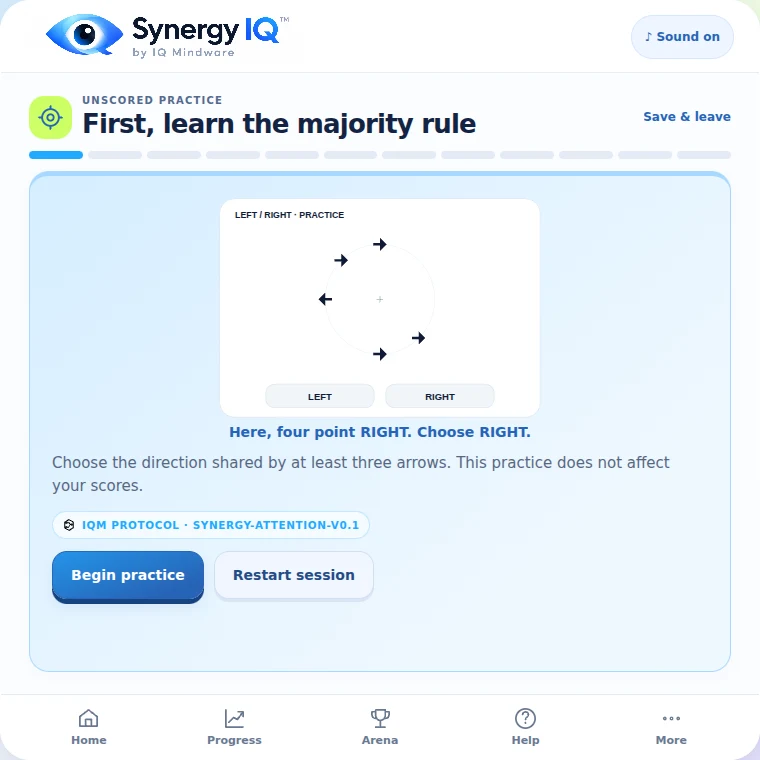
Attention control is the ability to keep task-relevant information dominant while resisting distraction, interference and competing signals. Synergy IQ Attention Control turns that control problem into a 12-block training session: build supported capacity, practise Adaptive Control under Precision, Balanced and Speed objectives, then recover the same majority-signal rule when later sessions change the task surface. Optional Strategy Practice connects the same question to an everyday cue.
Distraction is not simply a failure to concentrate. Often the problem is competition: several signals are available, but only some of them matter for the current goal. A notification, another thought, a vivid cue or a competing task can be more salient than the information that actually deserves control of the next response.
Can I keep the relevant signal dominant when other signals compete?
That is the core problem targeted by Attention Control. It is narrower than the older Cognitive Control Coach, which combined several control demands in one programme. Synergy IQ separates those capacities into distinct nodes so that each one can be trained, measured and transfer-tested more clearly.
“Attention control training” is used for several different methods in psychology and clinical research. IQ Mindware Attention Control is a non-clinical cognitive-training programme focused on selective and interference control for cognitive performance. It is not Attention Training Technique, attention-bias modification, ADHD treatment or a diagnostic assessment.
What is attention control?
A practical definition of attention control is the ability to select information that is relevant to a current goal, maintain that selection and resist interference from competing information.
This is not the same as simply being alert. You can be awake, motivated and mentally active while still allowing the wrong signal to dominate. Attention control becomes especially important when the target is ambiguous, when several alternatives are plausible, or when irrelevant information is more salient than the information that actually matters.
Attention control, cognitive control and concentration
Cognitive control is the broader regulation of thought and action in line with current goals. It can involve attention, working memory, inhibition, switching, updating and decision policy. Attention control is one component of that wider system: which information wins continued processing.
Concentration is the everyday experience of staying with a task. Attention control describes one mechanism that supports concentration. This is why searches such as cognitive control definition, cognitive control training and concentration control often point towards the same family of problems while referring to different levels of explanation.
Why does distraction win?
Competing information is not always weak or irrelevant. It may be novel, emotionally important, rewarding, threatening or simply easier to process than the task you intended to continue. Attention therefore has to solve a prioritisation problem repeatedly.
When the target signal is clear, this is easy. When the evidence is nearly balanced, when the task is dull, or when several cues appear meaningful, interference rises. The practical skill is not “ignore everything”. It is to identify what matters for the current goal and protect that representation until the situation genuinely changes.
What is interference control?
Interference control is the ability to resist disruption from information that competes with the current goal or response. It overlaps with selective attention and executive attention.
The Attention Control task creates interference deliberately. Several local signals point in different directions while the correct answer depends on the relation across the whole pattern. The user has to integrate the evidence instead of responding to whichever element is most visually conspicuous.
What happens in an Attention Control session?
The main training session contains 12 scored blocks after a short unscored practice. The two halves ask related but different questions.
- Find the signal. Identify the majority direction while competing signals create interference.
- Build supported capacity. In Blocks 1–6, presentation time adapts as the programme estimates a workable evidence-processing demand.
- Change control policy. Blocks 7–12 keep the supported demand fixed while Precision, Balanced and Speed objectives reward different parts of the speed–accuracy trade-off.
- Change the surface across sessions. Later challenge sessions can preserve the majority rule while changing direction axis, introducing optic flow or adding task-irrelevant emotional distraction, followed by return to the original LEFT/RIGHT task.
- Apply the rule. Optional Strategy Practice uses short everyday scenarios and can turn the cue into an IF/THEN plan for a later check-in. Strategy responses never alter the 12-block game score.
A typical session is designed to fit a short training block rather than an open-ended game. The programme keeps Capacity, Adaptive Control and optional Strategy Practice as distinct parts of the training journey.
What the Synergy IQ Attention Control node trains
The node isolates one operation: adaptive majority-signal extraction under interference. In the baseline task, several arrows contribute evidence towards a dominant direction. The task is to identify the majority rather than one individual cue.
Training difficulty and feedback use direct task performance while keeping the two halves distinct. The main product measures include:
- Capacity — supported evidence-processing demand from the adaptive first six blocks;
- Adaptive Control — performance across the fixed-demand Precision, Balanced and Speed blocks;
- accuracy and exposure demand — whether the majority signal is identified correctly as presentation time changes;
- response-time diagnostics — useful descriptive information kept separate from the canonical Adaptive Control point rule.
Why the task changes: backbone training and wrapper change
A persistent problem in cognitive training is that people can become expert at the interface rather than at the intended cognitive operation. If every trial looks the same, improvement may reflect familiarity with one display, one rhythm or one response routine.
Attention Control therefore uses a stable backbone majority judgement and then changes the wrapper. The anchor task uses static LEFT/RIGHT directional signals. Challenge sessions can switch to UP/DOWN, replace the static carrier with optic-flow motion, or add task-irrelevant emotional-face salience while preserving the underlying control problem.
Same control problem. Different surface.
The learner trains the backbone, encounters a changed representation, then returns to the original task. The purpose is not to claim transfer automatically. It is to create a stronger test of whether the trained relation can be recovered when superficial cues change.
How does the training adapt?
Adaptation should keep the task demanding enough to require control without making the signal arbitrary. As performance becomes stable, difficulty can increase; when performance breaks down, the task can step back into a range where useful learning remains possible.
The important principle is that difficulty is not an end in itself. The target is controlled learning: improve the core operation, perturb the conditions, recover it, and check whether the performance survives the change.
From capacity to strategy: “What information actually matters here?”
Synergy IQ does not treat the training game as the entire intervention. Each node is intended to connect a capacity to a simple retrievable strategy and then to repeated use in a real cognitive niche.
For Attention Control, the strategy cue is:
What information actually matters here?
The cue makes the trained operation explicit. After the mandatory game session, optional Strategy Practice presents short scenarios, lets the user choose a relevant attention policy and can turn it into one IF/THEN plan for later review. In a research paper this might mean identifying evidence that discriminates between competing explanations. In a meeting it can mean returning to the decision variable after several side issues appear. In AI-assisted work it can mean preserving the original question while the model generates many plausible but secondary directions. Strategy Practice is tracked separately from the game score so you can review how the principle was used.
Does attention control training transfer?
This is the central question, and it cannot be answered by the training score alone. Improvement on a trained task is evidence of learning that task. A stronger claim requires performance to survive increasing changes in representation, measure, context and time.
IQ Mindware therefore distinguishes:
- trained-task improvement — performance improves on the backbone exercise;
- changed-format performance — the same control relation is recovered under a different wrapper;
- separate transfer checks — performance is tested with a task that is not simply another version of the training interface;
- delayed checks — gains are re-tested after time has passed;
- applied use — the strategy is deliberately recruited in meaningful work, learning or decision contexts.
Evidence boundary
Attention Control is informed by research on executive-function and cognitive-control training, but evidence for this specific product remains to be established. IQ Mindware separates in-game improvement from evidence of transfer to other tasks or everyday outcomes.
Attention control in AI-assisted work
Generative AI can reduce search effort and increase the number of alternatives available. That can be useful, but it can also create a new attention problem: more outputs, more branches and more plausible directions competing for judgement.
In this setting, attention control means preserving the task frame. What question is actually being answered? Which evidence is diagnostic? Which attractive detail can safely be ignored? Which new signal is important enough to change the plan?
The same selection problem becomes especially relevant when AI produces many plausible options quickly: the human still has to preserve the goal, identify diagnostic evidence and decide what deserves attention.
Why Attention Control comes first in the Synergy IQ network
Synergy IQ separates training into a network of cognitive capacities rather than asking one exercise to represent “general intelligence”. Attention Control is the first node because many later operations depend on relevant information surviving long enough to be used.
One Synergy IQ hypothesis is that stronger attention control can improve the conditions under which other capacities are learned. Relational-memory training, for example, may become more productive when irrelevant information is less likely to disrupt the relations being maintained. The network is designed to track those learning interactions over time.
The wider network includes Relational Memory, Binding Memory, Path Horizon, Knowledge Access, Generative Search and Reasoning. Synergy IQ is designed to measure their learning trajectories separately and then examine whether useful interactions emerge over time.
Attention Control is available now
Synergy IQ Attention Control is the first live dedicated training node. The current public price is $20 for 12 months of access. Sign in with the email used at checkout to unlock the programme inside Synergy IQ.
The older Cognitive Control Coach remains a legacy combined programme. Its broader attention, working-memory and decision-timing functions are being separated into clearer Synergy IQ nodes. The dedicated Attention Control guide and app now provide the current route for this capacity.
Buy Attention Control — $20 →
See its role in the Synergy IQ network →
Read the legacy Cognitive Control Coach guide →
Frequently asked questions
What is attention control?
Attention control is the ability to keep task-relevant information dominant while resisting distraction, interference and competing signals.
Is attention control the same as concentration?
No. Concentration is the everyday experience of sustained focus. Attention control is more specific: selecting what matters and protecting it when other information competes.
What is the difference between attention control and cognitive control?
Attention control concerns selection and protection of relevant information. Cognitive control is broader and can also include working-memory maintenance, inhibition, switching, updating and decision policy.
Can attention control be trained?
Attention-control tasks can be practised and trained-task performance can improve. Whether those gains transfer to different tasks or everyday outcomes must be tested separately.
How does Attention Control relate to intelligence?
Attention control is one of the capacities linked to intelligent performance. Synergy IQ trains it as the first node in a wider network and uses separate measures to examine how training relates to broader cognitive development over time.
Is this the same as Cognitive Control Coach?
No. Cognitive Control Coach combined attention, working-memory and decision-timing demands. The new Synergy IQ architecture separates those capacities. Attention Control is the dedicated node for majority-signal selection under interference.
Is Attention Control an ADHD treatment or diagnostic test?
No. It is a cognitive training product, not a diagnosis, treatment or medical assessment.
Evidence and transfer
Attention Control is research-informed cognitive training built around selective attention, interference control, adaptive demand and deliberate changes in task conditions. The programme tracks direct performance, robustness across changed wrappers and separate application/transfer checks rather than relying on one training score.
For the deeper evidence base and how IQ Mindware evaluates broader transfer, see Science & evidence and the guide to far transfer.