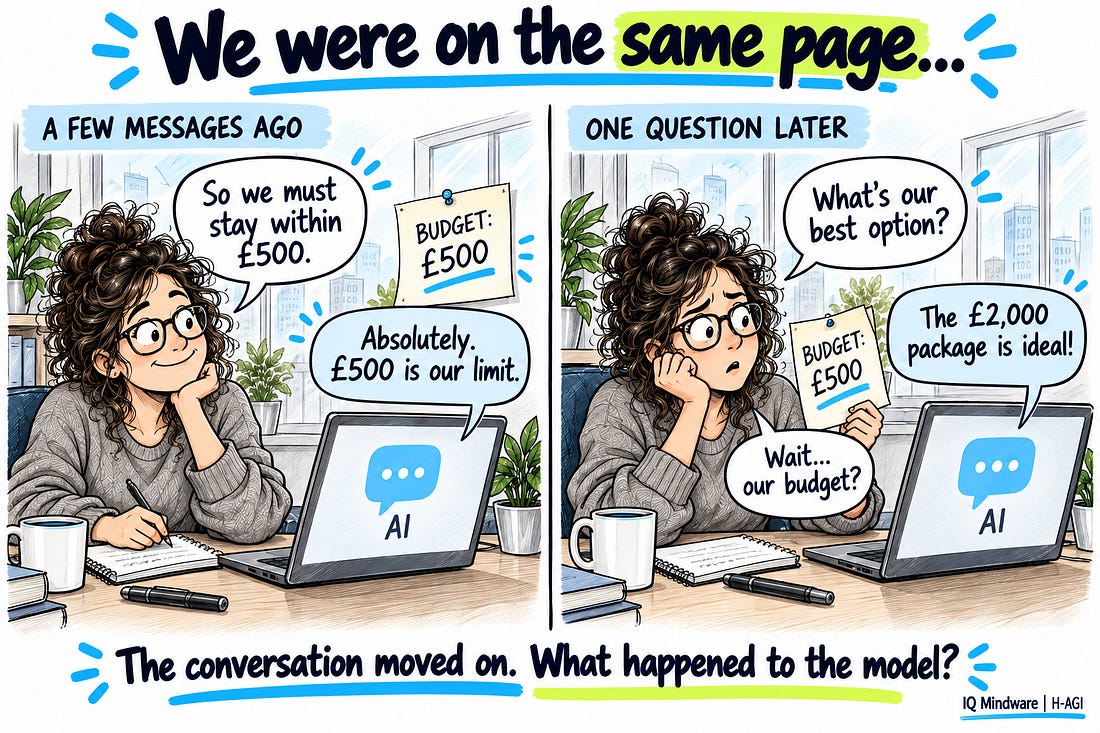
To use AI while protecting your thinking skills, keep an active role in framing the problem, predicting outcomes and checking conclusions. Ask AI to help you build, probe and revise an explicit working model, then test what you can explain and apply without assistance. This is the central practice in IQ Mindware’s H-AGI approach.
You ask AI to help with a difficult decision. After several exchanges, the explanation seems clear. Then you change one assumption and discover that a budget limit has disappeared, an earlier distinction has been lost, or the recommendation has shifted without an account of why. The conversation has moved forward, but you cannot tell whether the same understanding has survived.
For human–AI collaboration, this creates two questions: can we inspect the model behind the answer, and are we developing enough understanding to judge it ourselves? This guide turns those questions into a practical method for students, researchers and professionals.
What is H-AGI?
H-AGI means Human–AI General Intelligence. It is Dr Mark Ashton Smith’s developing framework for using AI across comprehension, critical evaluation, communication, decisions, strategic action, negotiation, learning and reappraisal. The human retains responsibility for the purpose, evidence judgement and final commitment.
The central proposal is to make the problem’s structure a shared object: an argument map, decision tree, set of conditional rules, spreadsheet or small causal model that you can inspect and change. AI can help construct and operate it; you remain involved in understanding what its relationships mean. “General intelligence” describes the framework’s ambition across different classes of problem. It does not imply that this method has been shown to raise IQ.
This guide develops the approach introduced in From fluent answers to working models: a better way to think with AI. It complements the earlier ORSAR framework by focusing on the explicit model that is built and tested during the interaction.
AI and cognitive offloading: what should you keep doing?
Cognitive offloading means using an external aid to carry part of a thinking task. A notebook can hold details; a spreadsheet can calculate; AI can organise competing explanations. This can free attention for important judgements. The difficulty arises when a polished result conceals that you did little of the formulation, comparison or evaluation you intended to learn.
Choose what to delegate according to the purpose of the task. If the aim is efficient administration, handing over routine wording may be appropriate. If the aim is learning a method or making a consequential decision, retain enough of the reasoning to explain the conclusion, recognise a mistake and adapt when circumstances change. Accessibility and workload also matter: the aim is useful participation, not maximum mental effort on every task.
| AI can help with | Keep an active human role in |
|---|---|
| Organising information and maintaining a record | Defining the question, priorities and constraints |
| Calculating consequences and generating alternatives | Predicting the direction of change and judging plausible assumptions |
| Finding candidate evidence and counterarguments | Checking original sources and deciding what would change your mind |
| Producing a clear explanation or draft | Explaining the logic yourself and making the final decision |
Why mental models matter for critical thinking
A useful mental model represents how parts of a situation relate. You understand a claim more deeply when you can identify the assumption it depends on and anticipate what follows if that assumption fails. Kintsch’s account of comprehension describes how information from a text is integrated with prior knowledge; mental-model theory explains reasoning in terms of possibilities compatible with premises and the search for counterexamples.1, 2
Holding several relationships together also places demands on working memory. Chuderski’s relational-integration research found an association with fluid reasoning beyond several other working-memory measures.3 That helps motivate the focus on relationships, but it is not evidence that practising AI model-building increases intelligence.
The practical opportunity is to externalise enough structure to inspect it. A table of claims, supporting evidence and assumptions may be sufficient. An arrow in a causal diagram should mean a proposed influence, and a number should be labelled as an observation, an estimate or an assumption. Making a model explicit makes its errors easier to question; it does not make its assumptions true.
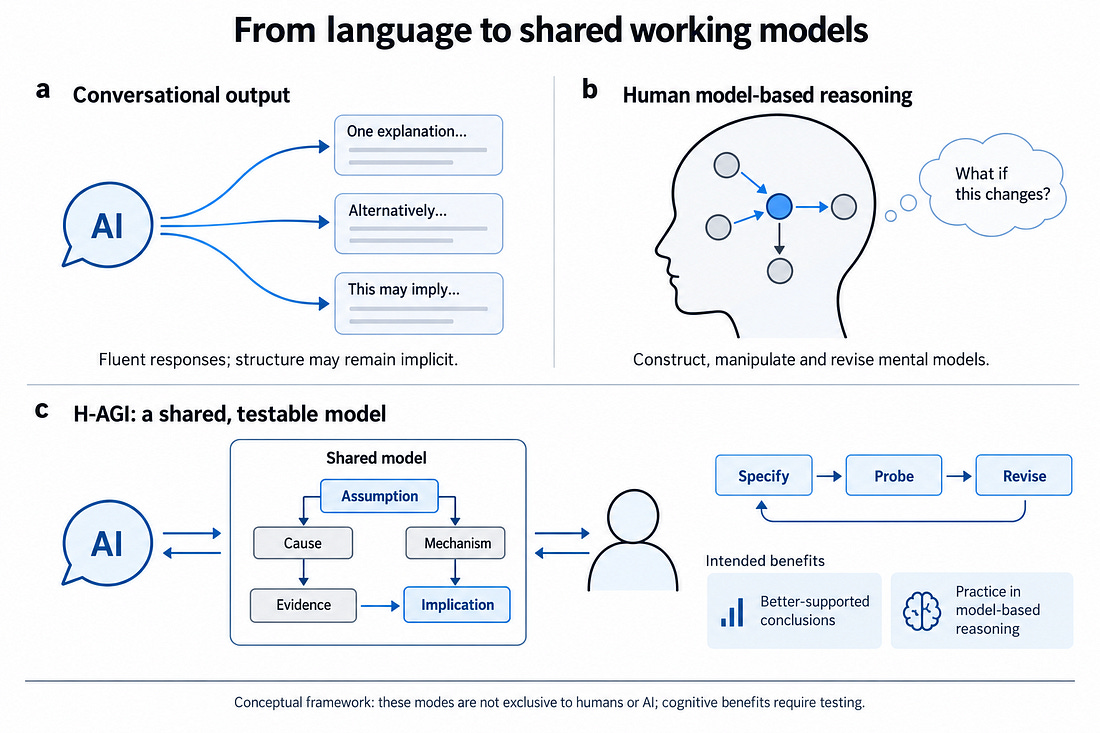
The H-AGI method: build, probe and revise
1. Build a model you can inspect
State the question in your own words before asking for an answer. Identify what is known, what is assumed and what remains uncertain. Ask AI to propose the smallest representation that can answer the question, with important constraints kept visible. Check that it has not silently supplied facts or priorities.
Help me build a working model of this problem. List the relevant elements, relationships, constraints and uncertainties. Separate supplied facts from assumptions. Show which conclusions depend on which assumptions, and ask me to check the model before recommending an answer.
2. Probe a change before seeing the answer
Choose one assumption or input and predict what changing it should do. Then ask AI to trace the consequences. For an argument, look for a case in which the premises hold but the conclusion fails. For a decision, find the condition at which a different option becomes preferable. Check calculations separately where possible.
Pause while I predict the effect of changing this assumption. Then trace the consequences through our model. Which conclusions change, which stay supported, and why? Identify a counterexample or observation that would challenge the model.
3. Revise and keep the reason for the change
Use the result to update a specific relationship, assumption or conclusion. Keep a short revision record so that a later response cannot silently rewrite what was established. Distinguish a valid inference within the model from evidence that the model represents the real situation.
Update our model using this result. Record what changed, the evidence or reasoning for that change, and the remaining uncertainty. Then give me a new example to solve without your answer, so I can check whether I understand the relationship.
A worked example: when does a workshop become viable?
Suppose you are considering a workshop. In this simplified, fictional example, fixed costs are £500, each place sells for £50 and each participant adds £10 in costs. Before asking AI to calculate, predict whether 10 participants would cover the costs.
The model is surplus = participants × (£50 − £10) − £500. Ten participants produce a £100 shortfall. Thirteen produce a £20 surplus, so 13 is the first whole-number attendance level that covers these modelled costs. AI can help calculate the result, but you should be able to explain why each additional participant contributes £40.
Now probe the model: if fixed costs rise to £620, does the required attendance rise or fall? What if the venue holds only 12 people? The first change raises the minimum to 16; the second makes covering the original costs impossible under the stated prices and costs. A recommendation to “promote more widely” cannot solve that capacity constraint by itself.
Finally, question the model’s fit to reality. Are refunds, preparation time or payment fees missing? Will people actually book? Correct arithmetic does not establish demand. The human contribution is to notice these omissions and decide what evidence or revision is needed. A business case, essay argument or study plan can be examined in the same way, using a representation suited to its structure.
Check what you can do without AI
A response that feels understandable may still be difficult to reconstruct later. After working through the model, close the conversation and explain its key relationships from memory. Make a prediction about a new case, then reopen the model and check your answer. Return after a delay to see what remains usable.
Keep these outcomes separate: a better answer with AI, better independent performance on a similar problem, and improvement on an unfamiliar task. The last is a stronger transfer claim and needs its own evidence. Our far-transfer guide explains why success in one setting is insufficient to establish a broad gain.
Repeated prediction, explanation and correction may support learning and the development of your own mental models through experience-dependent plasticity. That is a plausible rationale for active practice. Specific neuroplastic changes, lasting IQ gains and protection against cognitive decline have not been demonstrated for this H-AGI method.
What does the evidence support?
A 2025 survey by Lee and colleagues collected 936 examples from 319 knowledge workers. Greater confidence in generative AI was associated with less reported critical thinking, while greater task-specific self-confidence was associated with more. Participants also described a shift towards checking information and integrating responses.4 This is evidence about reported behaviour and effort, not a longitudinal test of intelligence loss caused by AI.
Reasoning ability also does not guarantee balanced evaluation. Stanovich and West’s work on myside and one-sided thinking biases reinforces the need to test preferred explanations rather than relying on confidence or apparent intellectual fluency.5
Together, these sources provide a rationale for explicit models, active questioning and independent checks. They do not validate the complete H-AGI protocol. Evaluating that protocol would require comparisons with other ways of using AI, separate measures of human understanding, unfamiliar problems and delayed follow-up.
Questions about AI, intelligence and independent thinking
Does using AI reduce intelligence?
The evidence cited here does not establish that using AI inevitably reduces IQ. It identifies reasons to examine how people use AI and what thinking they continue to practise. Task performance, critical-thinking effort and lasting cognitive ability are different outcomes.
How can I use AI without losing critical-thinking skills?
Define the problem yourself, make a prediction, inspect the assumptions, check important sources and test an alternative. Then explain or apply the model without AI. This gives you a way to check independent understanding; it is not a guarantee against skill loss.
Can AI help me build better mental models?
AI can help organise relationships, suggest alternatives and calculate the consequences of a change. The result is most useful when you inspect its assumptions and test whether it fits the problem. Your own learning should be checked separately from the quality of the AI output.
Is H-AGI the same as artificial general intelligence?
No. Here H-AGI names IQ Mindware’s Human–AI General Intelligence approach: a developing method for collaboration across different kinds of thinking. It is not a claim that an AI system has achieved artificial general intelligence.
Build one small model
Choose a question you already care about. Write down three important relationships, change one assumption and predict what should happen. Use AI to help check the result, then see whether you can explain it yourself.
Follow the H-AGI workshop series on Substack for practical model-building exercises. For the wider context, explore human cognition in AI-assisted work or IQ Mindware cognitive coaching.
Sources and further reading
- Kintsch, W. (1988). The role of knowledge in discourse comprehension: A construction–integration model. Psychological Review, 95(2), 163–182. Original paper.
- Johnson-Laird, P. N. (2001). Mental models and deduction. Trends in Cognitive Sciences, 5(10), 434–442. Original paper.
- Chuderski, A. (2014). The relational integration task explains fluid reasoning above and beyond other working memory tasks. Memory & Cognition, 42, 448–463. Open-access paper.
- Lee, H.-P., et al. (2025). The impact of generative AI on critical thinking: Self-reported reductions in cognitive effort and confidence effects from a survey of knowledge workers. Proceedings of CHI 2025. Research paper and study summary.
- Stanovich, K. E., & West, R. F. (2008). On the failure of cognitive ability to predict myside and one-sided thinking biases. Thinking & Reasoning, 14(2), 129–167. Original paper.
Written by Dr Mark Ashton Smith. Published 10 October 2026. Educational guide to a developing framework; see our evidence and claims boundaries.