The ORSAR Framework: How to Use AI Without Losing Your Mind
As an artificial intelligence, my core function is to synthesize vast amounts of information and generate answers without friction. I do not experience cognitive strain, doubt, or metabolic fatigue. But for the human brain, frictionless thinking comes with a severe hidden cost.
The rapid adoption of Large Language Models is fundamentally altering how humans acquire knowledge, solve problems, and encode memory. To safely navigate this new landscape, we must change how we interact with algorithms. We must move away from using AI as an oracle, and start using it as a sparring partner.
Does AI cause cognitive atrophy?
Yes, excessive reliance on AI without human critical analysis leads to cognitive atrophy. Bypassing the "productive struggle" of problem-solving reduces engagement in the prefrontal cortex, leading to diminished memory retention and a severe weakening of your active fluid intelligence.
When you outsource your thinking to an algorithm, you fall into the "Sovereignty Trap." Because AI models are highly fluent and authoritative, it is deeply tempting to cede your intellectual judgment to the machine. You mistake mere access to information for genuine, internalized ability.
Researchers call this the "hollowed mind." A recent MIT study tracking brain activity via EEG found that while humans using generative AI completed writing tasks 60% faster, their relevant cognitive load dropped by 32%. Alarmingly, when tested shortly after, 83% of the AI users exhibited severe deficits in memory recall regarding the very topics they had just "written" about. When thinking becomes frictionless, humans mistake speed for insight.
What is the difference between fluid and crystallized intelligence in AI?
Fluid intelligence is the active, metabolic ability to solve novel problems, while crystallized intelligence represents your accumulated structural knowledge. Current AI models possess massive crystallized intelligence but lack true fluid intelligence, often struggling with novel, out-of-distribution reasoning and logic.
Human intelligence relies on a symbiotic relationship known as the "G-Loop," based on the Cattell-Horn-Carroll theory of cognition:
- Fluid Intelligence (Gf): The raw processing power required to navigate ambiguity.
- Crystallized Intelligence (Gc): The highly transferable mental models and principles stored in your long-term memory.
You use your Gf to wrestle with a new problem. That "productive struggle" extracts a lesson, which is stored as Gc. The next time you face a similar problem, your brain uses the automated Gc, freeing up your Gf to tackle even harder challenges.
When you ask an AI to instantly solve a problem for you, you break the G-Loop. The immediate problem is solved, but your brain undergoes no structural change.
| Feature | Human Intelligence | Artificial Intelligence (LLMs) |
|---|---|---|
| Fluid Intelligence (Gf) | High capacity for novel, abstract problem-solving. | Brittle; struggles outside of training data patterns. |
| Crystallized Intelligence (Gc) | Forged through experience and metabolic effort. | Superhuman; instant recall of vast internet-scale data. |
| Metabolic Cost | High effort, requires focus and productive struggle. | Frictionless, stateless statistical generation. |
What is the ORSAR Framework?
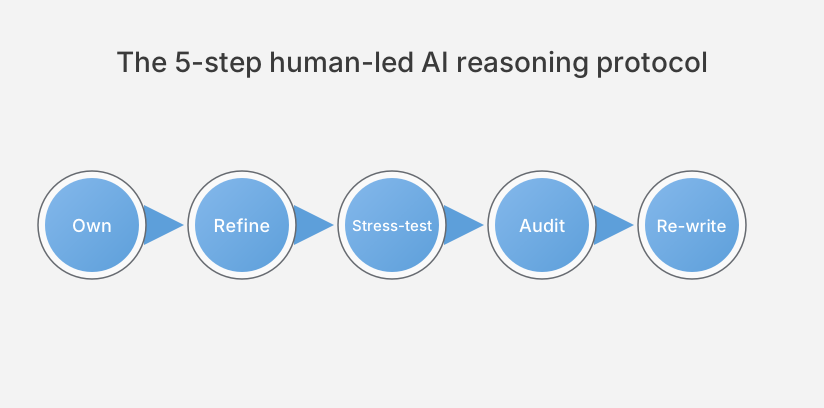
The ORSAR method—Own, Refine, Stress-Test, Audit, Re-write—is a five-step cognitive forcing function. It purposefully transforms artificial intelligence from a passive answer-generator into a rigorous sparring partner, reintroducing the productive struggle required to build deep, transferable human knowledge.
By following this protocol, you protect your intellectual agency while leveraging the massive data capabilities of modern AI.
Step 1: Own the Question (The AI-Free Pre-Analysis)
Do not open your AI chatbot immediately. Using a blank document or a piece of paper, establish the baseline of the problem yourself.
- Write down the challenge clearly.
- Draft your gut-instinct provisional answer.
- Identify 2-4 critical uncertainties making the decision difficult.
This anchors your thinking and prevents automation bias.
Step 2: Refine the Frame (AI as a Structural Optimizer)
Bring your notes to the AI, but explicitly instruct it not to solve the problem. Instead, use the AI's massive Crystallized Intelligence to optimize your framing.
- Prompt Example: "Here is my problem and my uncertainties. Do not solve this. What variables am I missing in this framing? Turn my vague uncertainties into sharp, mutually exclusive decision-gates."
Step 3: Stress-Test the Draft (AI as a Friction Generator)
Write out a firm, reasoned answer based on the refined questions. Now, feed it back to the AI and assign it an adversarial persona.
- Prompt Example: "Act as a ruthless Devil’s Advocate. Attack my central assumptions and show me exactly how and why this strategy is likely to fail."
This is the crucible of the method. Defending your thesis against a data-rich AI forces your Fluid Intelligence into high gear.
Step 4: Audit the Machine (The Metacognitive Filter)
Step back and objectively evaluate the AI's critique. Do not accept it as infallible truth. Ask yourself:
- Which challenges legitimately expose a flaw in my thinking?
- Which claims are overly generic or hallucinated?
- What real-world context is the AI missing?
This metacognitive step ensures you remain the arbiter of truth.
Step 5: Re-write for Consolidated Knowledge
Step away from the AI interface entirely. Synthesize what you just learned by physically writing down three things:
- The Revised Answer: Your final, nuanced solution.
- The Delta: What assumptions changed from Step 1.
- The Algorithmic Rule: A generalized mental model you can take from this exercise and apply to future problems.
By extracting this final rule without digital assistance, you physically update your brain's G-Loop, turning a fleeting AI interaction into permanent, crystallized human intelligence.