Human-Led AI Reasoning Protocol: 10-Day Challenge
Why this matters now
AI is now a default part of study and work. That shift creates leverage, but also a new risk: cognitive drift. Over time, people can outsource first-pass mapping, argument structure, and judgement to the model and lose quality in their own reasoning.
This protocol is built for knowledge workers, founders, and professionals who want AI to augment intelligence without surrendering cognitive ownership.
The 5-step human-led AI protocol
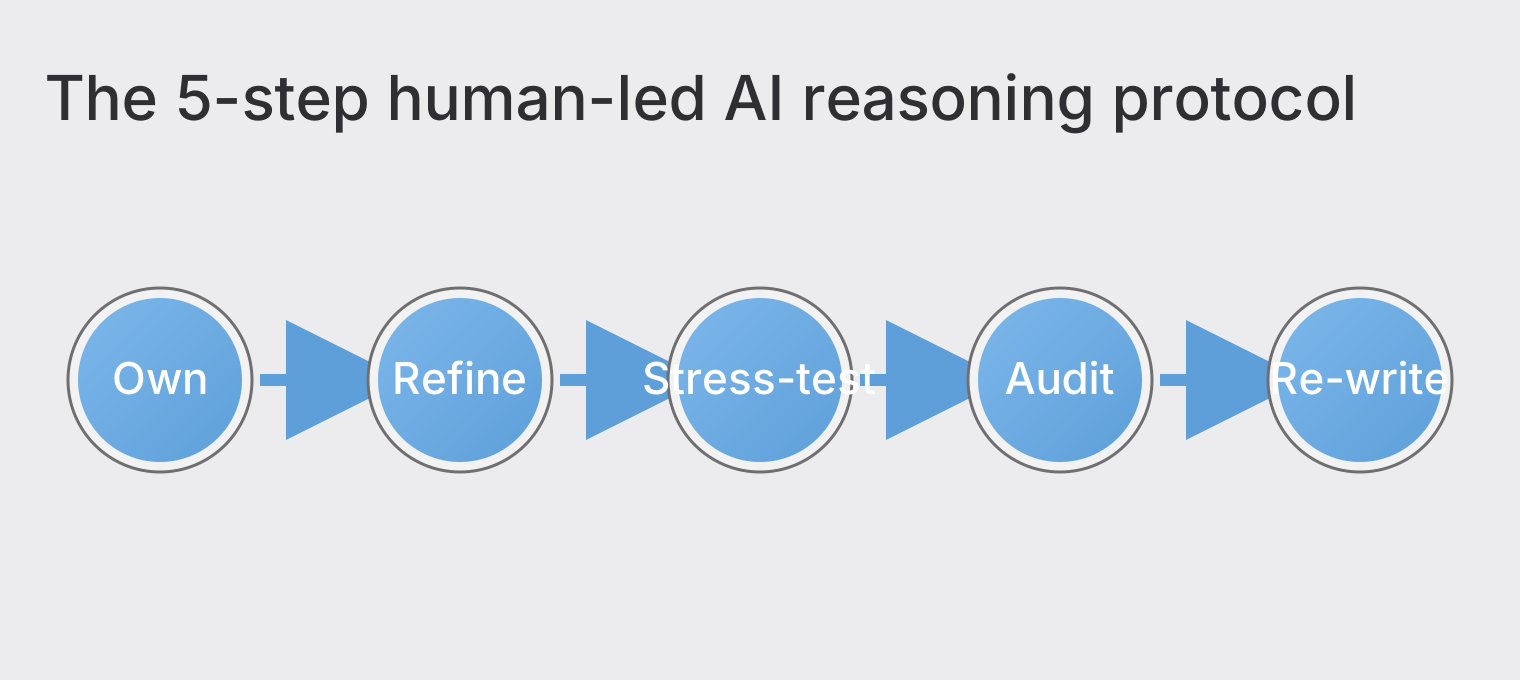
The core sequence is simple:
- Own the question
- Refine the frame
- Stress-test the draft
- Audit the machine
- Re-write with judgement
This is not a speed hack. It is a control sequence for keeping human judgement in charge while still using AI for challenge and clarity.
How each step works in practice
1) Own the question
Before using AI, write three things in your own words: the problem, your provisional answer, and two to four real uncertainties. This keeps you upstream of model assumptions.
2) Refine the frame
Ask AI to sharpen your questions, not solve the decision yet. Better decisions usually start with better question quality.
3) Stress-test the draft
Write your short answer first. Then ask AI to challenge it in Socratic mode (clarify assumptions) or Devil's Advocate mode (find failure points).
4) Audit the machine
Evaluate output quality directly: what is strong, what is vague, what is missing, and what still needs evidence.
5) Re-write with judgement
Return to an AI-free pass and write your revised answer, what changed, what stayed stable, and one improved rule for next time.
10-day challenge structure
Run the full protocol on each significant live problem in one sitting, using real work rather than artificial exercises. In practice, this might include evaluating a workflow change, drafting a recommendation, pressure-testing a strategic proposal, planning a next step on a project, or responding to a high-stakes email or meeting decision.
- Days 1?2: run the full protocol on several live tasks to establish a baseline for clarity, speed, and judgement quality.
- Days 3?6: continue full-cycle runs, while noting recurring weak points such as vague framing, shallow challenge, poor audit discipline, or over-reliance on AI wording.
- Days 7?9: tighten the protocol by improving prompts, sharpening audit criteria, and making final re-written outputs more concise and decision-ready.
- Day 10: review all runs across the full period and compare early versus late performance in clarity, confidence calibration, reasoning quality, and resistance to cognitive drift.
The goal is not to complete the steps in isolation. It is to see whether the full loop improves thinking under real workload pressure.
Bottom line
Human-led AI reasoning means using models as structured challenge partners, not authority substitutes. When the sequence is followed, AI can sharpen mapping, testing, and decision quality while keeping ownership with the human operator.
For claims boundaries and method posture, see /proof#claims and /proof#protocols.