Latest N-Back Brain Training Studies: Effective Sleep and Training Synergy
Review the latest n-back brain training studies, sleep and working-memory research, and why IQ Mindware uses n-back inside a broader Trident G training protocol.
N-back training has been one of the most debated forms of brain training. Some studies suggest that it can improve trained and closely related working-memory skills. Other studies and meta-analyses argue that broad ?IQ improvement? claims are not well supported.
So what should we conclude?
The best answer is neither ?n-back does nothing? nor ?n-back automatically raises IQ?. A more evidence-based conclusion is this:
N-back training can improve trained and closely related working-memory/updating skills. Sleep may help consolidate some training gains. But broad far transfer requires more than repeating a memory game. It requires a stronger training protocol: readiness, attention control, relational working memory, reasoning, varied task surfaces, delayed re-checks and real-world transfer tests.
That is the direction IQ Mindware takes with the Trident G protocol.
What is n-back training?
In a standard n-back task, you see or hear a stream of items and decide whether the current item matches the one presented n steps earlier. In a 2-back task, for example, you compare the current stimulus with the one two trials back.
Dual n-back increases the challenge by asking you to track two streams at once, such as visual locations and sounds. This makes it a demanding test of working-memory updating, attention control and resistance to interference.
But there is an important distinction:
Getting better at n-back is not the same thing as becoming generally more intelligent.
Training may improve performance on the trained task, and sometimes on closely related working-memory tasks. The harder question is whether this transfers to broader reasoning, problem solving, learning or real-world cognition.
What the Johns Hopkins n-back study found
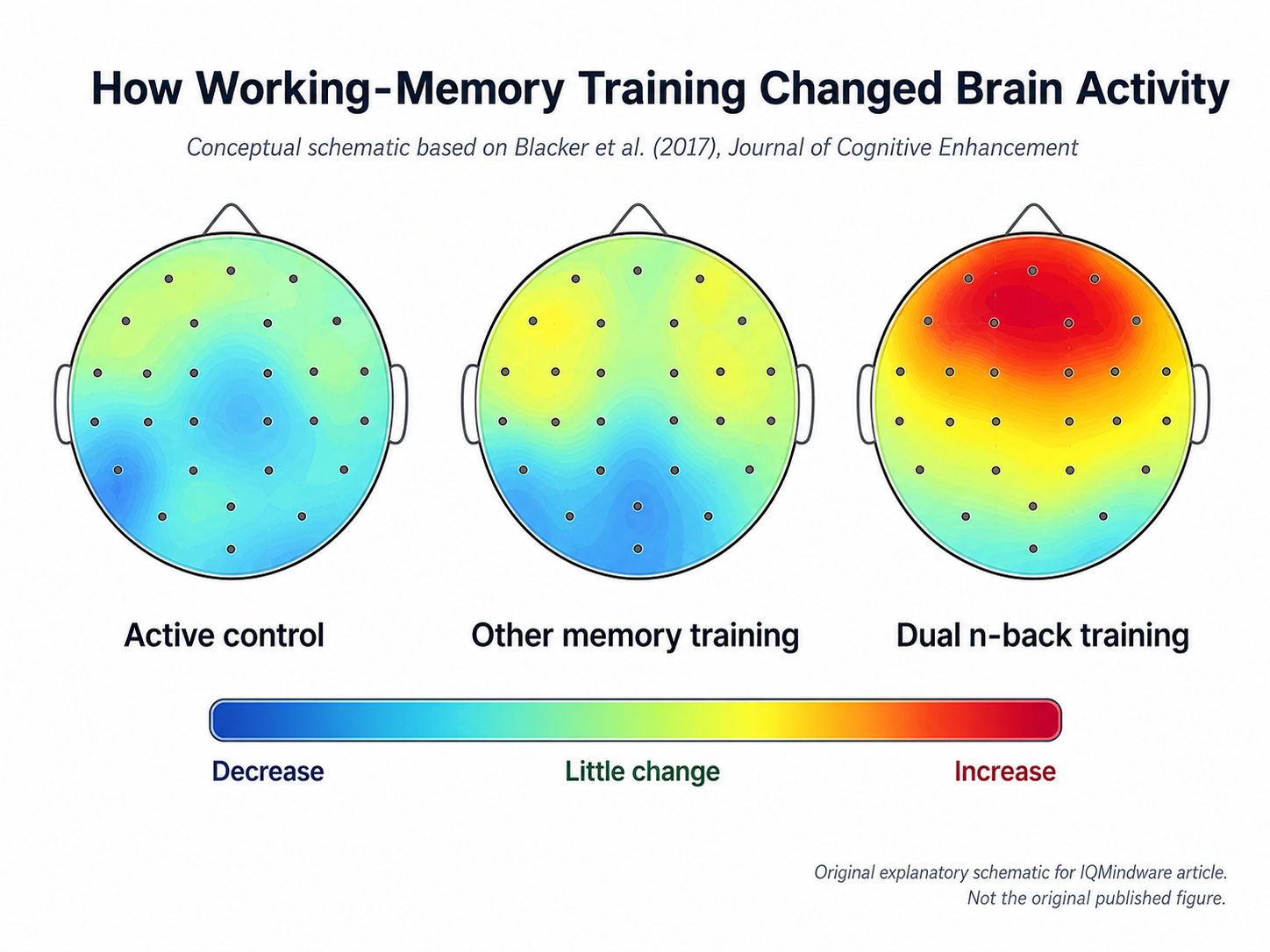
One useful study compared dual n-back training with complex-span working-memory training and an active control condition. Blacker, Negoita, Ewen and Courtney found evidence of near transfer for the dual n-back group, but did not find far transfer to fluid intelligence. They also reported that dual n-back training produced greater frontal alpha-power changes during an EEG working-memory transfer task than the other groups. (Johns Hopkins University)
That matters because the result is more nuanced than a simple ?brain training works? headline.
It suggests that dual n-back can change task-relevant working-memory performance and associated neural activity, but it does not prove that dual n-back broadly increases IQ.
What the meta-analyses say
The wider literature is mixed, and that is exactly why strong claims need care.
Au and colleagues reported that working-memory training produced a small positive effect on fluid-intelligence outcomes in their meta-analysis. (PubMed) But Melby-Lerv?g, Redick and Hulme reached a more sceptical conclusion in a larger review, arguing that working-memory training produces short-term gains on trained or similar tasks, but no convincing evidence of reliable far transfer to intelligence or real-world cognitive skills when compared with treated control groups. (Sage Journals)
More recent individual studies also keep the picture cautious. Ripp and colleagues tested eight weeks of adaptive n-back training in middle-aged adults and found no near or far transfer effects, and no convincing neuroimaging changes relative to a non-adaptive control condition. (Nature)
The clean conclusion is:
N-back is a useful working-memory/updating training tool, but it should not be marketed as a standalone IQ-increase method.
This is why IQ Mindware treats n-back as one component inside a broader transfer-oriented system.
Why sleep may matter after n-back training
One of the most interesting findings for practical training is that sleep can support consolidation after working-memory practice.
Zinke, Noack and Born studied sleep after n-back training and reported that overnight sleep facilitated training-induced improvements in working memory in children and adults. Their paper specifically highlights that sleeping after n-back training increased optimum performance. (Ovid)
This does not mean that doing n-back before bed automatically raises IQ. That would be too strong.
A better interpretation is:
Training creates a candidate learning trace. Sleep may help stabilise, reorganise or consolidate that trace.
This fits a broader view of learning: the brain does not simply improve during practice. Some of the useful change happens after practice, especially during rest, sleep and delayed re-checks.
For IQ Mindware, this supports a practical training principle:
Do not only measure immediate gains. Re-check after delay.
If a gain disappears the next day, it may have been a short-lived practice effect. If it survives sleep, spacing and a changed task surface, it becomes more interesting.
The frontoparietal control network: why flexible control matters
N-back training is partly interesting because it engages controlled attention and working-memory updating. These functions are closely related to the frontoparietal control network.
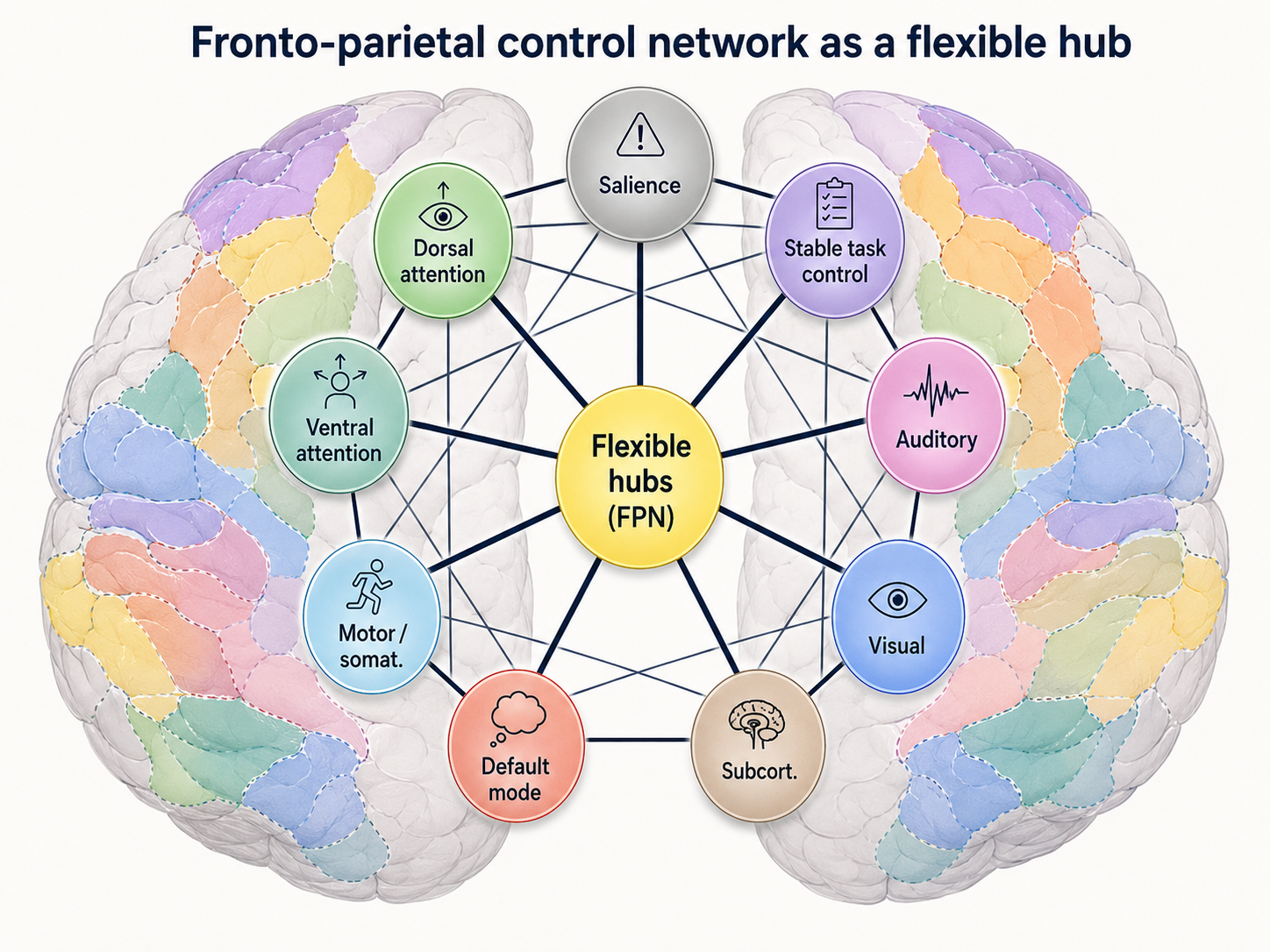
Cole and colleagues proposed that the frontoparietal network acts as a set of flexible hubs. These hubs rapidly change their connectivity with other brain systems according to task demands. In simple terms, the frontoparietal network helps coordinate different systems depending on what the task requires. (Nature)
This is important for brain training because real intelligence is not just about storing items in memory. It is about flexibly coordinating attention, perception, working memory, task rules, reasoning and action.
Why IQ Mindware goes beyond standard n-back
The limitation of ordinary n-back is that users can become better at the task without necessarily learning a portable cognitive skill.
In other words, the user may become skilled at:
?playing this specific memory game?
rather than improving:
?the ability to bind variables, update relational structure and transfer a control policy into new problems.?
This is where the Trident G protocol differs from standard brain-training logic.
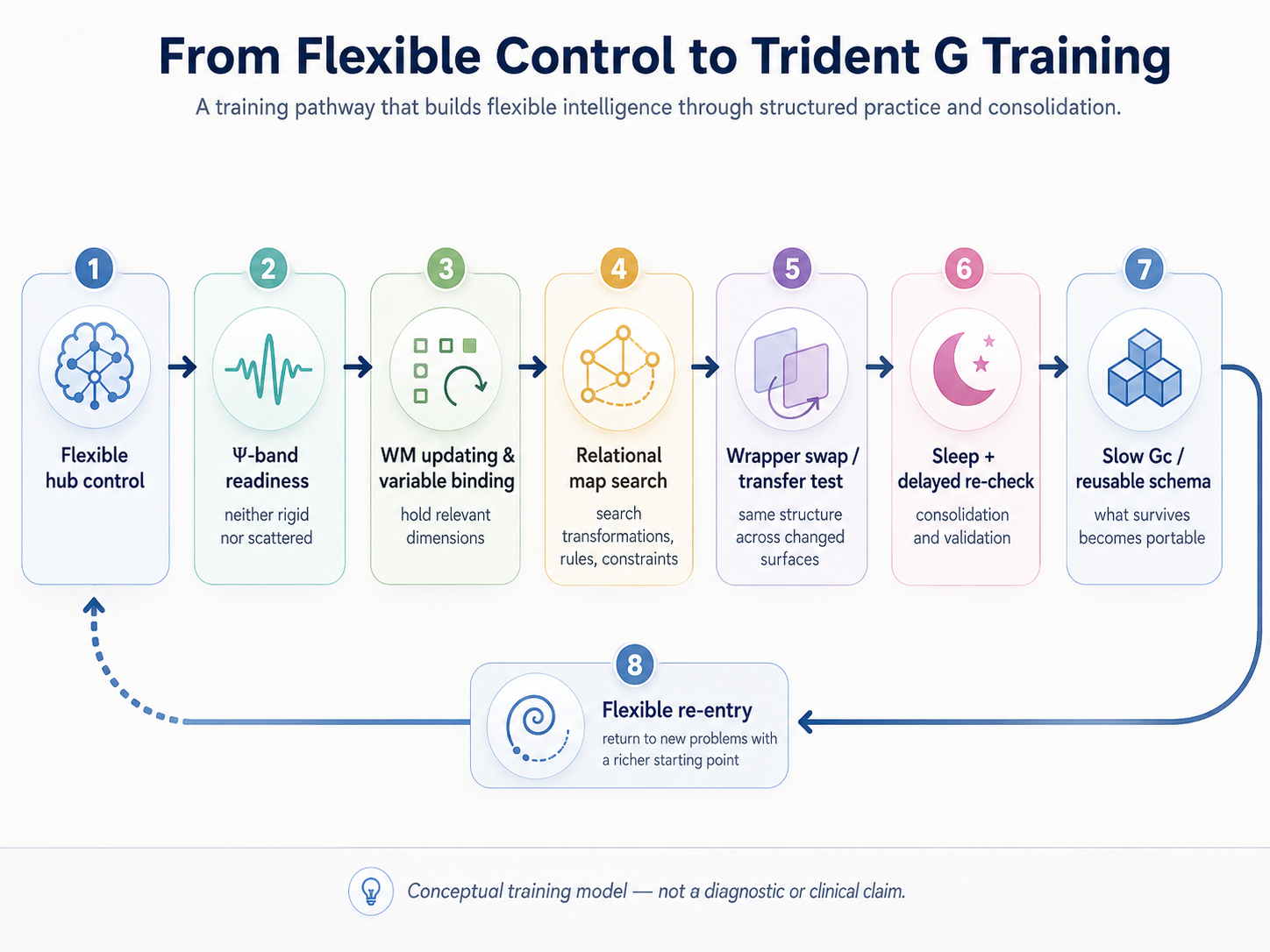
In the Trident G framework, n-back is useful because it trains part of the active workspace: updating, resisting interference, holding recent information and maintaining task-relevant structure. But far transfer requires additional steps:
- Check readiness and state.
- Train working-memory updating and attention control.
- Bind the relevant variables.
- Search relational structure.
- Change the wrapper or task surface.
- Test whether the same structure survives.
- Re-check after delay.
- Consolidate what survives into reusable skill.
This is the difference between task improvement and transfer-oriented training.
From n-back to relational working memory
A newer direction in cognitive training is to move beyond simple item matching.
Standard n-back often asks:
?Is this item the same as the item n steps ago??
A more transfer-relevant version asks:
?Is this relation, change, rule or structure the same??
That is a more ambitious training target because it moves from item memory to relational working memory. It is also closer to the kind of cognition needed for reasoning, analogy, planning and problem solving.
This is the rationale behind IQ Mindware?s movement towards relational working-memory training and mission-based reasoning tasks. The goal is not merely to increase n-back level. The goal is to train the user to track variables, relations, constraints and transformations across changing contexts.
This is also why a stronger IQ Pro pathway would include:
- Zone or readiness checks.
- Adaptive working-memory training.
- Relational working-memory tasks.
- Reasoning and problem-space missions.
- Meta-cognitive prompts.
- Wrapper swaps.
- Delayed re-checks.
- Evidence-safe progress tracking.
The strongest claim is not:
?This app proves far transfer.?
The stronger and more honest claim is:
This protocol is designed to test and train the conditions under which transfer may occur.
Practical training advice: how to use n-back more intelligently
If you use n-back or related working-memory training, the evidence suggests a few sensible principles.
First, do not treat the task score as the whole goal. A higher n-back level is useful only if it helps build more portable attention and working-memory control.
Second, avoid training when you are too tired, overloaded or distracted. A short readiness check before training may help prevent low-quality practice.
Third, use spacing. Short, consistent sessions are likely to be better than exhausting bursts.
Fourth, include sleep. Training followed by sleep may help consolidate working-memory gains, but the claim should be ?may support consolidation?, not ?guaranteed IQ increase?.
Fifth, test transfer. After training, ask whether the skill survives a changed task, a delayed re-check or a real-world use case.
A good training sequence is:
readiness check
? working-memory updating
? relational reasoning
? changed task surface
? delayed re-check
? real-world mission
That is the logic behind IQ Mindware?s Trident G direction.
Conclusion: n-back is useful, but transfer needs a system
The latest n-back evidence is not a simple win or loss for brain training.
A fair conclusion is:
N-back training can improve trained and closely related working-memory/updating skills. Sleep may help consolidate some training gains. But broad IQ or far-transfer claims require stronger evidence and stronger protocol design.
That is why IQ Mindware does not treat n-back as a magic IQ button.
Instead, n-back sits inside a broader adaptive-intelligence pathway: readiness checking, working-memory updating, relational reasoning, problem-space missions, wrapper variation, delayed re-checks and proof tracking.
N-back builds part of the active workspace.
Transfer requires the whole system.
Suggested call to action
Try Trident G IQ Pro
Train working memory, attention control and reasoning inside a structured 20-session adaptive-intelligence programme.
Start Trident G IQ Pro
Use the in-app Coach-led route for readiness checks, relational working memory, reasoning training, and far-transfer proof.
References
- Au, J., Sheehan, E., Tsai, N., Duncan, G. J., Buschkuehl, M., & Jaeggi, S. M. (2015). Improving fluid intelligence with training on working memory: A meta-analysis. Psychonomic Bulletin & Review, 22(2), 366?377. https://doi.org/10.3758/s13423-014-0699-x
- Blacker, K. J., Negoita, S., Ewen, J. B., & Courtney, S. M. (2017). N-back versus complex span working memory training. Journal of Cognitive Enhancement, 1(4), 434?454. https://doi.org/10.1007/s41465-017-0044-1
- Cao, D.-Y., Zhang, T.-N., Zhang, Y., & Zhang, G.-L. (2026). Broad and sustained transfer effects of executive n-back working memory training. Psychonomic Bulletin & Review.
- Cole, M. W., Reynolds, J. R., Power, J. D., Repov?, G., Anticevic, A., & Braver, T. S. (2013). Multi-task connectivity reveals flexible hubs for adaptive task control. Nature Neuroscience, 16(9), 1348?1355. https://doi.org/10.1038/nn.3470
- Li, W., Zhang, Q., Qiao, H., Jin, D., Ngetich, R. K., Zhang, J., Jin, Z., & Li, L. (2021). Dual n-back working memory training evinces superior transfer effects compared to the method of loci. Scientific Reports, 11, Article 3072. https://doi.org/10.1038/s41598-021-82663-w
- Melby-Lerv?g, M., Redick, T. S., & Hulme, C. (2016). Working memory training does not improve performance on measures of intelligence or other measures of ?far transfer?: Evidence from a meta-analytic review. Perspectives on Psychological Science, 11(4), 512?534. https://doi.org/10.1177/1745691616635612
- Ripp, I., Emch, M., Wu, Q., Lizarraga, A., Udale, R., von Bastian, C. C., Koch, K., & Yakushev, I. (2022). Adaptive working memory training does not produce transfer effects in cognition and neuroimaging. Translational Psychiatry, 12, Article 512. https://doi.org/10.1038/s41398-022-02272-7
- Zinke, K., Noack, H., & Born, J. (2018). Sleep augments training-induced improvement in working memory in children and adults. Neurobiology of Learning and Memory, 147, 46?53. https://doi.org/10.1016/j.nlm.2017.11.009